At Sparkle Technologies, one of the things we do is help our private equity clients navigate the data and technology side of roll-up strategies — it’s the problem our data warehouse design practice exists to solve, and one we see so often we wrote it up as a pattern. We’ve seen firsthand how quickly complexity compounds — one of our clients acquired 28 companies in their first 16 months. At that pace, every week of delay in getting consolidated reporting costs real money and real visibility. The challenges below are ones we encounter on every engagement, and the solutions reflect what we’ve learned building the infrastructure that keeps these platforms running.
Good data isn’t just an operational nice-to-have — it’s the foundation that both the operators running the business and the investors overseeing it depend on. For operators, clean and consolidated data means they can identify underperforming locations, optimize pricing, manage capacity, and make decisions with confidence instead of gut instinct. For the PE firm, it means reliable board reporting, the ability to track value creation across the hold period, a clear picture of customer concentration and margin trends, and — when it’s time to exit — a data-backed story that withstands buyer diligence and commands a premium multiple.
When the data is messy, both sides suffer. Operators fly blind, making decisions on incomplete or conflicting information. Investors lose visibility into what’s actually happening across the portfolio and can’t quantify the value they’ve built. In a roll-up, where the entire thesis depends on demonstrating that the combined platform is worth more than the sum of its parts, the ability to prove that with data isn’t optional — it’s the difference between a good exit and a great one.
Roll-ups are one of private equity’s most reliable value creation playbooks. Buy a fragmented industry’s smaller players, consolidate operations, realize synergies, and exit at a multiple that reflects the scale of the combined platform. Simple in theory. In practice, the data and technology layer is where roll-up strategies quietly stall.
The problem isn’t that firms don’t recognize data matters. It’s that the data challenges in a roll-up are fundamentally different from those in a single-company acquisition. Each new add-on multiplies complexity in ways that most operating teams underestimate until they’re already behind.
Here’s where things break down — and what the best-run platforms do differently.
The “N Systems” Problem
A typical roll-up of regional services companies might bring together six or seven acquisitions in the first two years. Each one shows up with its own ERP, its own CRM, its own accounting software, and its own way of defining basic concepts like “customer,” “job,” or “revenue.”
Company A tracks revenue at the contract level. Company B tracks it at the invoice level. Company C has a custom-built Access database that one employee understands. None of them define “gross margin” the same way.
This isn’t a minor inconvenience. It means the platform can’t answer fundamental questions: How many customers do we actually have? What’s our blended gross margin by service line? Which locations are underperforming? These are the exact questions the board asks at every meeting, and for the first 12 to 18 months, the answers are often stitched together manually in spreadsheets — slow, error-prone, and impossible to audit.
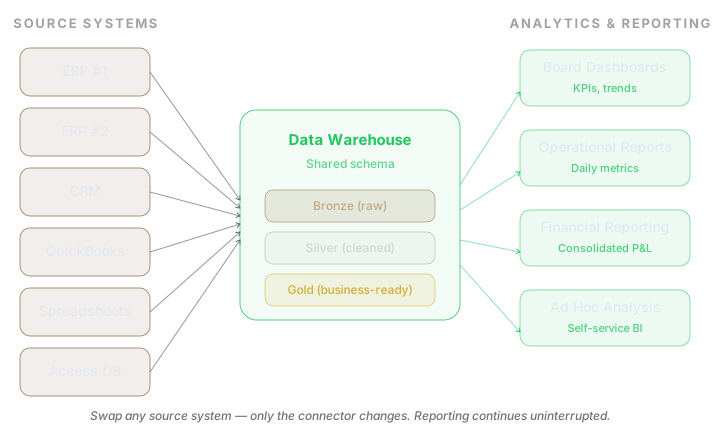
How to solve it: Resist the urge to force everyone onto a single system immediately. Instead, build a lightweight integration layer — a centralized data warehouse that ingests data from each portfolio company’s existing systems and maps it to a shared schema. Define the 15 to 20 critical fields and standardize those first. This gives leadership a single source of truth for reporting without the operational disruption of ripping out systems mid-integration.
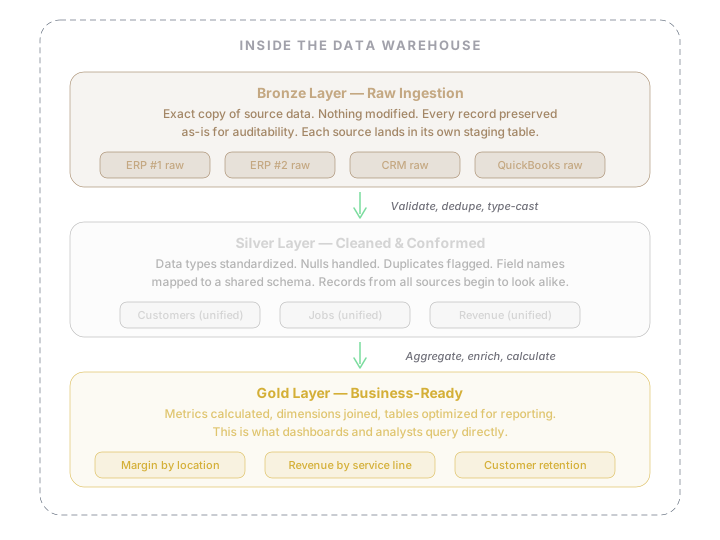
Done right, the warehouse itself is organized into layers — commonly called the bronze, silver, and gold medallion architecture — that progressively clean and transform data as it moves from raw ingestion to business-ready reporting.
The bronze layer is a raw, unmodified copy of the data exactly as it arrives from each source system. Nothing is changed, cleaned, or filtered. Every record is preserved as-is, giving the team a full audit trail and the ability to reprocess data if something goes wrong downstream.
The silver layer is where the real work begins. Data from the bronze layer is validated, deduplicated, type-cast, and mapped to a shared schema. This is where “Company A calls it a contract and Company B calls it an invoice” gets resolved — both get mapped to the same standardized revenue record.
The gold layer is what the business actually sees. Tables here are optimized for reporting and analysis — metrics are pre-calculated, dimensions are joined, and the data is structured to answer the questions leadership asks most often. Analysts and operators never need to touch bronze or silver; they work exclusively with gold.
This layered approach matters in a roll-up because it creates a repeatable, disciplined process for onboarding each new add-on’s data. Every acquisition follows the same path: raw data lands in bronze, gets cleaned and conformed in silver, and surfaces as business metrics in gold. The complexity of six different source systems is absorbed by the warehouse’s internal architecture, and what comes out the other end is a single, consistent view of the platform.
But here’s the critical insight: if the data warehouse layer is architected correctly, the decision about whether to consolidate onto a single ERP doesn’t have to hold reporting hostage. The warehouse sits as an abstraction layer between the source systems and the reporting tools that leadership relies on. When a portfolio company eventually transitions from one system to another — say, migrating from QuickBooks to NetSuite — the only thing that changes is the connector. The dashboards still work, and the metrics leadership tracks don’t skip a beat.
There’s another major benefit that often gets overlooked: the warehouse dramatically simplifies the system migration itself. One of the most painful parts of moving a company from one system to another is migrating historical data. When the data warehouse is already in place and has been ingesting data from the original system all along, that historical data is already captured, standardized, and accessible. The migration to the new system can focus entirely on getting the new system operational with clean, current data — without the burden of bringing over years of legacy history. That history still lives in the warehouse, fully available for reporting and trend analysis.
Inconsistent Data Quality Across Add-Ons
Not all acquisitions are created equal when it comes to data maturity. A $50M revenue company might have a dedicated IT team and clean Salesforce data. A $5M tuck-in might run its business out of QuickBooks and Gmail. When you roll these up into a single reporting structure, the weakest data becomes everyone’s problem.
Dirty data from one add-on doesn’t just affect that company’s numbers — it pollutes the consolidated view. Duplicate customer records inflate pipeline counts. Inconsistent job coding makes it impossible to compare margins across business units. Missing fields break dashboards that leadership depends on.
The danger is that teams lose trust in the data entirely. Once a CFO gets burned by a board report that turns out to be wrong because of a data quality issue from one add-on, the instinct is to go back to manual spreadsheets. That’s a step backward that’s hard to reverse.
How to solve it: Implement data quality checks at the point of ingestion, not after the fact. Every time a new add-on’s data flows into the central warehouse, it should pass through a validation layer that flags anomalies — missing fields, values outside expected ranges, duplicate records. Assign a data quality score to each source system and make it visible.
The Master Data Problem
Roll-ups create a master data management nightmare that single-company acquisitions simply don’t face. When you acquire six companies that all serve overlapping geographies, there’s a good chance they share customers. But each company has its own customer records, its own naming conventions, and its own account hierarchies.
Without resolving these overlaps, the platform can’t answer strategic questions like: How much total wallet share do we have with our largest customers? Are we competing with ourselves across business units? Where are the real cross-sell opportunities?
The same problem applies to vendor data, employee data, and product or service catalogs. Every entity that exists across multiple add-ons needs to be reconciled, and the difficulty scales nonlinearly with each acquisition.
How to solve it: Stand up a master data management process early. Begin with customers, since that’s where the strategic value is highest. Use a combination of deterministic matching (exact matches on tax ID, email, or address) and probabilistic matching (fuzzy matching on name and location) to identify overlaps. Create a golden record for each unique entity and map every source system’s records back to it.
The good news is that AI has dramatically improved the speed and accuracy of entity resolution. Machine learning models can now ingest messy, inconsistent records across systems and identify probable matches with a level of nuance that rule-based approaches can’t touch. They can learn that “Johnson & Sons HVAC” in one system and “Johnson and Sons Heating & Cooling LLC” in another are almost certainly the same company, even when the address fields don’t quite match.
But AI won’t get you to 100%. There will always be a tail of ambiguous records — partial matches, conflicting data, edge cases where two entities look similar but are genuinely different. That residual manual work is unavoidable, and how you handle it depends on volume. The key is to let AI handle the heavy lifting, define a clear confidence threshold below which records get routed to human review, and then staff that review process appropriately based on the size of the problem.
Reporting That Doesn’t Scale
Most roll-ups start with a finance team that manually consolidates Excel workbooks from each portfolio company into a single board deck. This works when you have two or three companies. It stops working fast.
The manual consolidation process introduces lag (reports are always weeks behind), risk (formula errors compound silently), and a bottleneck on the one or two people who understand the spreadsheets. More importantly, it limits the questions leadership can ask. When every new analysis requires rebuilding a spreadsheet, the team defaults to the same four or five metrics and misses the operational insights that actually drive value creation.
This matters for PE timelines. Funds don’t have the luxury of waiting two years for clean reporting. The hold period is finite, and the faster a platform can identify underperformers, optimize pricing, and demonstrate growth, the stronger the exit story.
How to solve it: Invest in automated reporting infrastructure in the first 90 days, not after the platform is “ready.” A modern BI layer sitting on top of the centralized data warehouse can deliver self-service dashboards that update automatically as new data arrives. Every new acquisition should slot into the reporting framework within weeks, not months. (Our guide to business intelligence for private equity covers the full reporting stack.)
Poor Business Processes Create Poor Data
This is the challenge that most data and technology conversations skip over entirely, and it might be the most important one.
It’s tempting to treat data problems as technology problems. But in many roll-up acquisitions, the root cause of bad data isn’t the technology — it’s the business processes that generate the data in the first place.
Consider a field services company where technicians close out work orders. If the process allows a tech to mark a job “complete” without entering labor hours, material costs, or a customer signature, then the resulting data is garbage — no matter how sophisticated the reporting layer is. A regional distributor where sales reps create customer accounts without a standardized naming convention will produce a CRM full of duplicates. A healthcare services roll-up where each clinic codes procedures differently will never produce reliable revenue-per-visit metrics until the coding process itself is standardized.
The pattern is the same every time: undisciplined processes at the point of data entry create downstream problems that no amount of engineering can fully clean up. You can build the most elegant data warehouse in the world, but if the inputs are incomplete, inconsistent, or wrong, the outputs will be too.
Your analysis is only as good as your data. Your data is only as good as the processes that create it.
This creates a tension with the speed that PE timelines demand. Operating partners want clean data and reliable KPIs quickly, but the business process changes needed to produce that clean data take time to implement and even longer to stick. The temptation is to skip the process work and just build better reports on top of the existing mess. That’s a trap. You end up with dashboards that look polished but are built on a foundation of unreliable data.
How to solve it: Treat business process standardization as a data initiative, not just an operations initiative. Identify the three or four processes that have the highest impact on data quality — usually job completion, customer creation, invoicing, and inventory management — and standardize those first across the platform. Define required fields, establish validation rules at the point of entry, and build accountability into the workflow. If a technician can’t close a work order without entering labor hours, labor hours get entered. Make data discipline part of operating reviews, not just something the IT team worries about.
Losing Institutional Knowledge During Integration
Here’s a subtler challenge. The people who best understand a portfolio company’s data — where it lives, what the quirks are, which fields actually mean what — are often the same people who are at risk during post-acquisition restructuring. When a roll-up centralizes back-office functions, it’s common to lose the tribal knowledge that kept each company’s data systems running.
This isn’t just an HR issue. It’s a data risk. Without documentation, the team inherits systems they don’t fully understand, data pipelines they can’t troubleshoot, and business logic that’s embedded in someone’s head rather than in code.
How to solve it: Treat knowledge capture as a formal part of the integration process. Before any restructuring, document each add-on’s data landscape: what systems exist, how data flows between them, what manual processes supplement the technology, and where the known issues are.
Planning for the Next Acquisition
The most overlooked data challenge in roll-ups isn’t about the companies you’ve already acquired — it’s about the ones you haven’t. Most platforms build their data infrastructure to accommodate the current portfolio and then scramble to adapt when the next add-on closes.
In an active roll-up strategy, acquisitions don’t stop. The data architecture needs to be designed with extensibility in mind from the beginning. Every schema decision, every integration pattern, every reporting framework should be built to accommodate the next company walking through the door.
How to solve it: Design the data platform as a repeatable onboarding machine. Create standardized connectors for the most common source systems in your industry. Build a documented onboarding playbook. The goal is to compress the time from close to consolidated reporting with every successive acquisition. What takes three months for the first add-on should take three weeks by the fifth.
The Bottom Line
Roll-ups create data challenges that are multiplicative, not additive. Each new acquisition adds complexity across systems, data quality, master data, reporting, business processes, and institutional knowledge. The firms that build a scalable data foundation early — not after the problems become painful — are the ones that capture the full value of their consolidation strategy.
And the firms that go further, recognizing that clean data starts with disciplined business processes and not just better technology, are the ones that build platforms where leadership can actually trust the numbers. Your analysis is only as good as your data. Your data is only as good as your processes. Get those right, and everything else follows.
The data layer isn’t a back-office concern. It’s the infrastructure that can make or break the operating thesis.