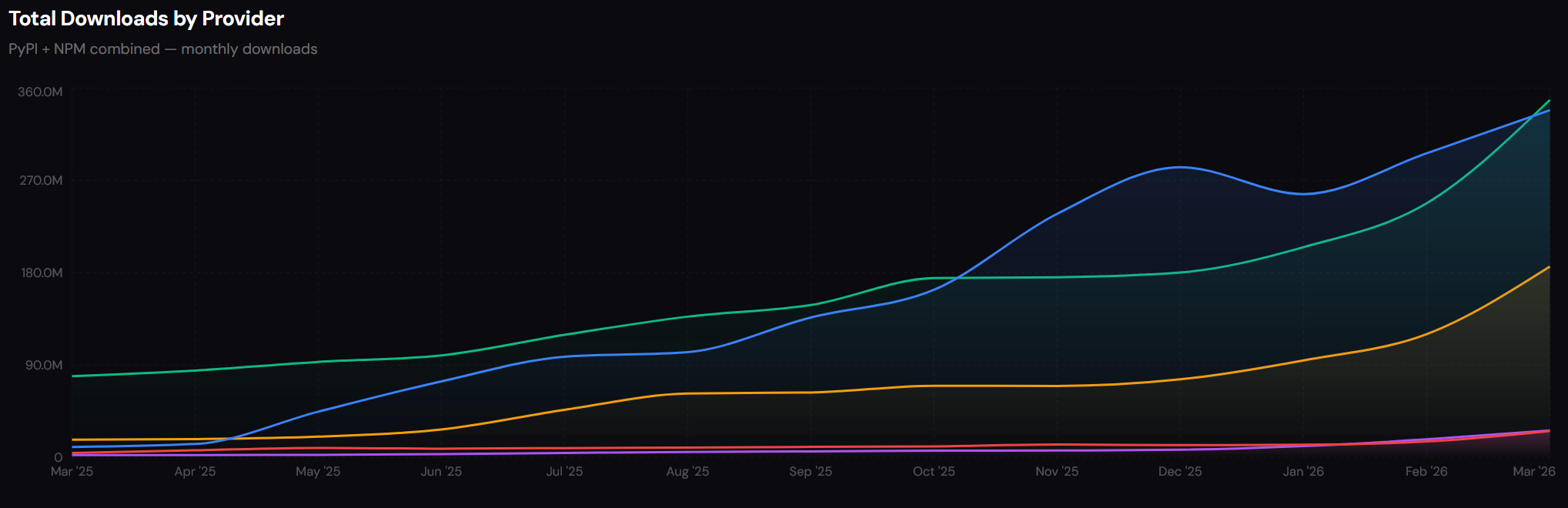
Combined PyPI + NPM monthly downloads. Google's steep rise should be interpreted with caution — see caveats below.
The AI industry loves to talk about benchmarks, funding rounds, and user counts. But if you want to know which AI companies developers are actually building on, there’s a simpler place to look: package managers and code repositories. Every time a developer runs pip install anthropic or npm install openai, that’s a signal. Every time someone creates a new GitHub repository importing an AI SDK, that’s a vote of confidence.
We tracked these signals across five major AI providers — OpenAI, Anthropic, Google, Mistral, and Cohere — from March 2025 through March 2026. The results tell a story that’s quite different from the consumer-facing narrative you’d get from chatbot traffic stats or media coverage.
What We’re Measuring (and What We’re Not)
Before diving into the findings, it’s worth being precise about what each data source captures.
PyPI downloads (Python Package Index) count every time someone installs a Python package via pip. This includes direct SDK installs like anthropic or openai, as well as framework integrations like langchain-openai. These numbers are high because they include CI/CD pipelines, automated builds, and dependency resolution — a single company might generate thousands of installs per day across their build systems. PyPI downloads measure infrastructure commitment: how deeply a provider’s SDK is embedded into Python workflows.
NPM downloads measure the same thing for the JavaScript ecosystem. Packages like @anthropic-ai/sdk, openai, and the Vercel AI SDK connectors track how developers building web applications, Node.js services, and serverless functions are integrating AI. The JavaScript ecosystem has historically been smaller for AI than Python, which makes the exceptions all the more interesting.
GitHub new repositories count how many new public repos are created each month that import a given provider’s SDK. Unlike downloads, which can be inflated by automated systems, a new repo represents a deliberate decision: someone started a new project and chose to build it on a specific AI provider. This is arguably the purest signal of developer adoption intent, though the absolute numbers are much smaller.
None of these metrics measure end-user adoption, consumer market share, or revenue. A company can have millions of chatbot users while generating relatively modest SDK downloads, and vice versa. These are developer ecosystem metrics — they tell you who developers are building with today, which shapes what end users will interact with tomorrow.
The Big Picture: An 8x Market in 12 Months
The most striking headline number is the sheer scale of growth across the entire AI developer ecosystem. Combined monthly downloads across all five providers grew from roughly 114 million in March 2025 to 926 million in March 2026 — an 8.1x increase. GitHub repo creation followed a similar trajectory, with monthly new AI repos more than quadrupling over the same period.
This isn’t one company’s success driving the total. Every provider in our dataset grew substantially. But the rates of growth diverged dramatically, and the relative positioning shifted in ways that would have been difficult to predict a year ago.
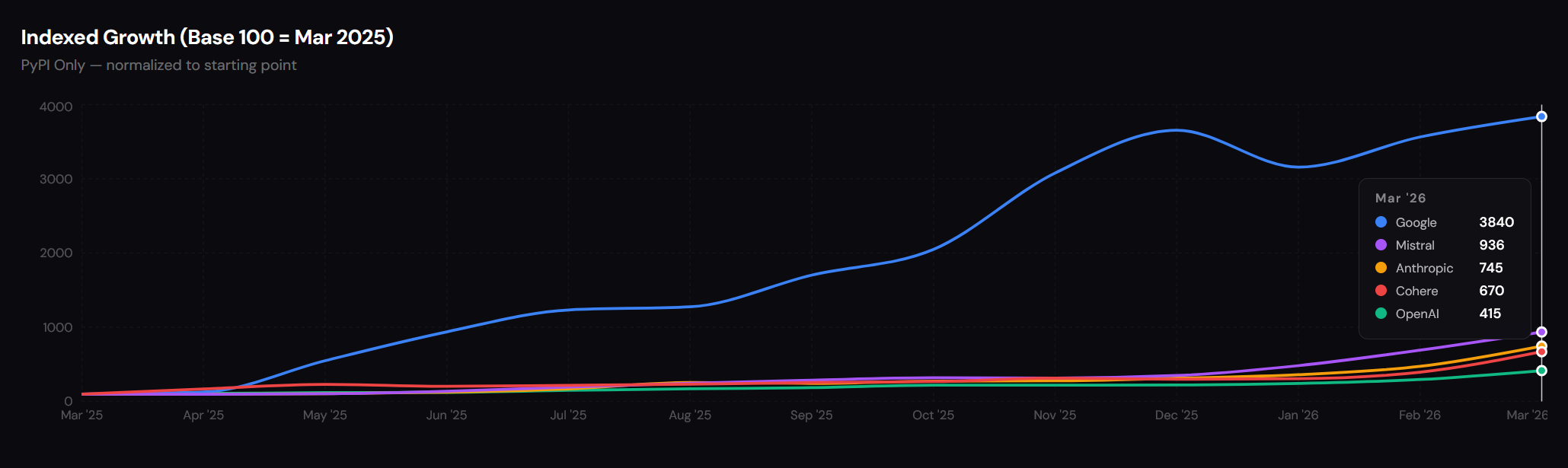
Each provider normalized to 100 at March 2025. Google's 32x headline growth is inflated by packaging effects; Anthropic's ~10x and Cohere's ~6x represent more organic trajectories.
Anthropic: The Breakout Story Among the Big Three
Of the three major providers — OpenAI, Anthropic, and Google — the most compelling growth story over this period belongs to Anthropic.
On an indexed basis, Anthropic’s combined downloads grew to approximately 1,068 by March 2026 — a roughly 10x increase. OpenAI reached approximately 439, a strong result but considerably slower in relative terms. Starting from the largest base, OpenAI’s growth was the most “expected” — it continued to scale steadily, but it didn’t accelerate the way Anthropic did.
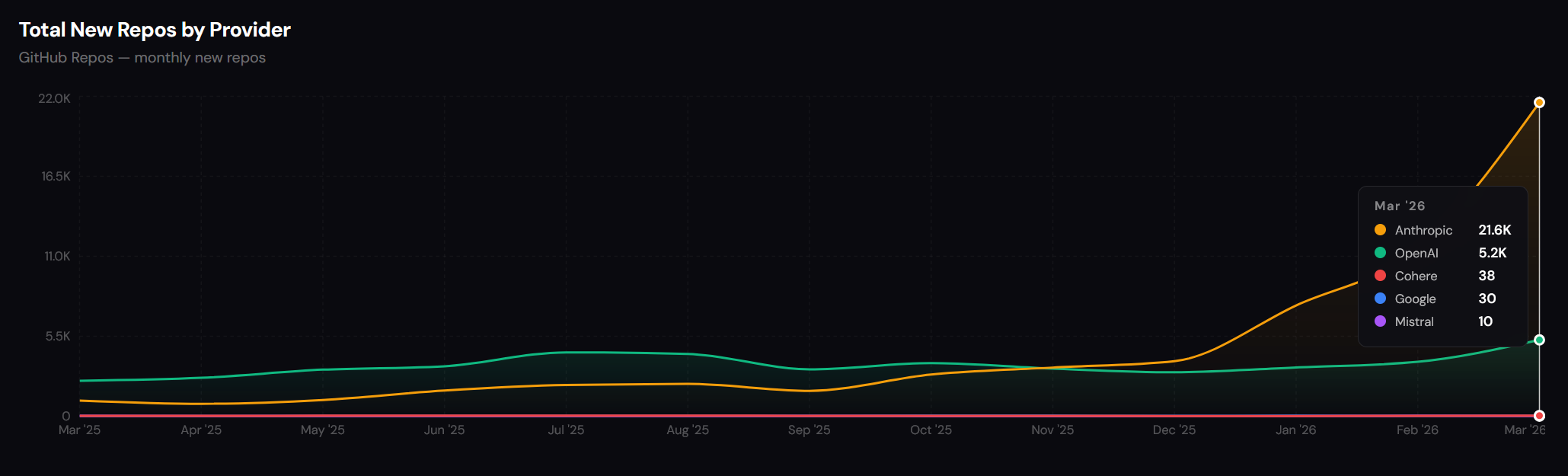
The GitHub data tells an even more dramatic story. In March 2025, developers created roughly 2,400 new repos using OpenAI’s SDK and about 1,100 using Anthropic’s. By October 2025, Anthropic had drawn even. By March 2026, developers were creating 21,579 new Anthropic repos per month versus 5,248 for OpenAI — a complete inversion of the hierarchy.
Monthly new GitHub repos importing each provider's SDK. Anthropic overtook OpenAI in November 2025 and has been accelerating since.
When developers start new projects, they are increasingly reaching for Claude first. The GitHub crossover in late 2025 is one of the clearest signals that the default developer choice is shifting.
The timing of Anthropic’s growth spurts is also telling. The sharpest acceleration on NPM came in July 2025, when Anthropic’s JavaScript downloads surged 105% month-over-month — likely tied to the launch of Claude Code and expanded model capabilities. On PyPI, the biggest spike came in August 2025 (+52.3%), followed by another surge in early 2026. These aren’t gradual trend shifts — they correlate with specific product releases that unlocked new developer workflows.
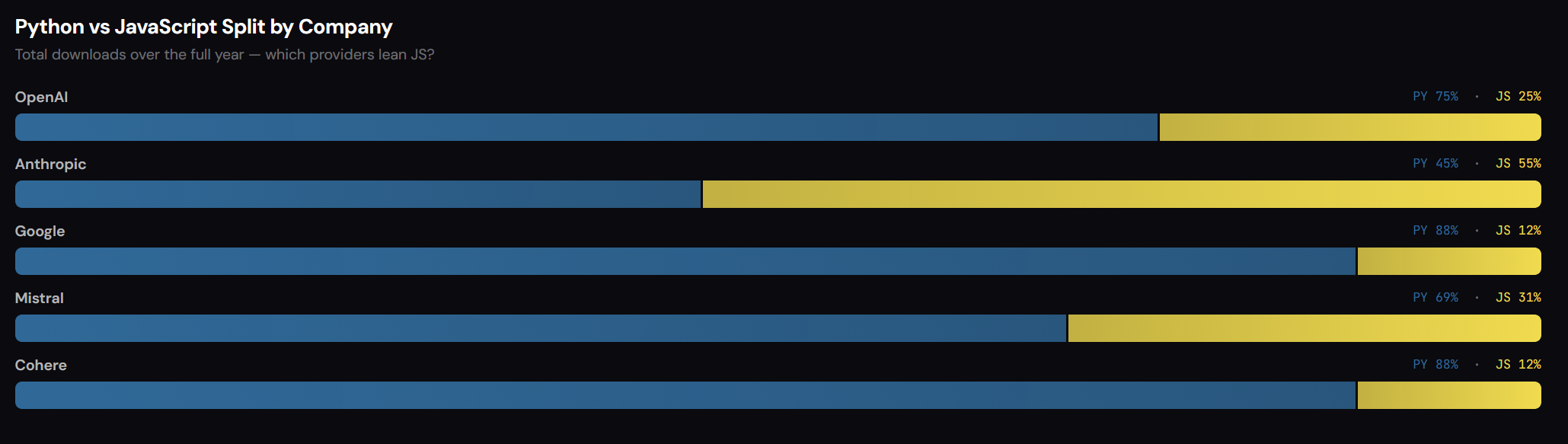
Anthropic is also the only major provider where JavaScript SDK downloads exceed Python. Across the full year, 55% of Anthropic’s total downloads came from NPM versus 45% from PyPI. Every other provider is overwhelmingly Python-first (75–90% PyPI).
Anthropic is the only provider where JavaScript downloads exceed Python — suggesting unique penetration into web and full-stack development workflows.
This suggests Anthropic has achieved unusual penetration into the JavaScript/TypeScript ecosystem — the world of web applications, serverless functions, and full-stack development — where the other providers remain primarily tools for Python-centric data science and ML engineering workflows.
The Google Caveat: Overcounting in the Data
Google’s numbers require a significant asterisk. On paper, Google shows the most explosive absolute growth of any provider: its combined downloads went from roughly 10 million in March 2025 to 339 million in March 2026 — a 32x increase that dwarfs everyone else.
However, much of this growth is likely overcounted from the perspective of pure AI development work. Google’s google-genai and google-generativeai packages are often bundled as dependencies within Google’s broader cloud ecosystem. When a developer installs Google Cloud client libraries, Firebase tools, or other Google infrastructure packages, the generative AI packages can come along for the ride — even if the developer never calls a Gemini API endpoint.
The magnitude of the spike supports this interpretation. Google’s PyPI downloads surged 337% in a single month (May 2025), coinciding with what appears to be a major SDK restructuring rather than a sudden groundswell of organic developer demand. Organic adoption curves tend to be steep but smooth; one-month jumps of that magnitude typically indicate a change in packaging or dependency structure.
This doesn’t mean Google’s AI developer adoption isn’t growing — it clearly is, especially on NPM where the AI SDK connectors show strong and steady growth. But the PyPI numbers should be interpreted more conservatively than the headline figures suggest.
Growth Rates Across the Board
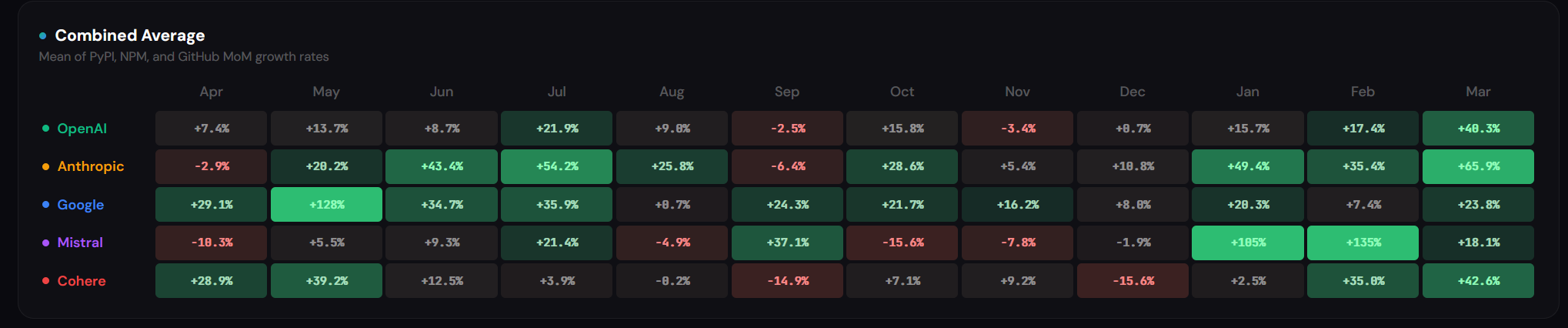
The heatmap below shows month-over-month growth rates averaged across all three data sources (PyPI, NPM, GitHub). This averaging helps smooth out the noise from any single source and gives a more balanced view of each provider’s momentum.
Average month-over-month growth rate across PyPI, NPM, and GitHub. Green = strong growth, red = contraction.
Several patterns emerge. March 2026 was a breakout month across the board — every company posted its strongest or near-strongest growth. Anthropic shows the most consistently warm row, with frequent months above 25%. OpenAI is the steadiest, rarely spiking or dipping as dramatically. Mistral had extreme late-period acceleration (104.6% in January, 135% in February), though from a much smaller base.
Python Still Dominates, But JavaScript Is Gaining
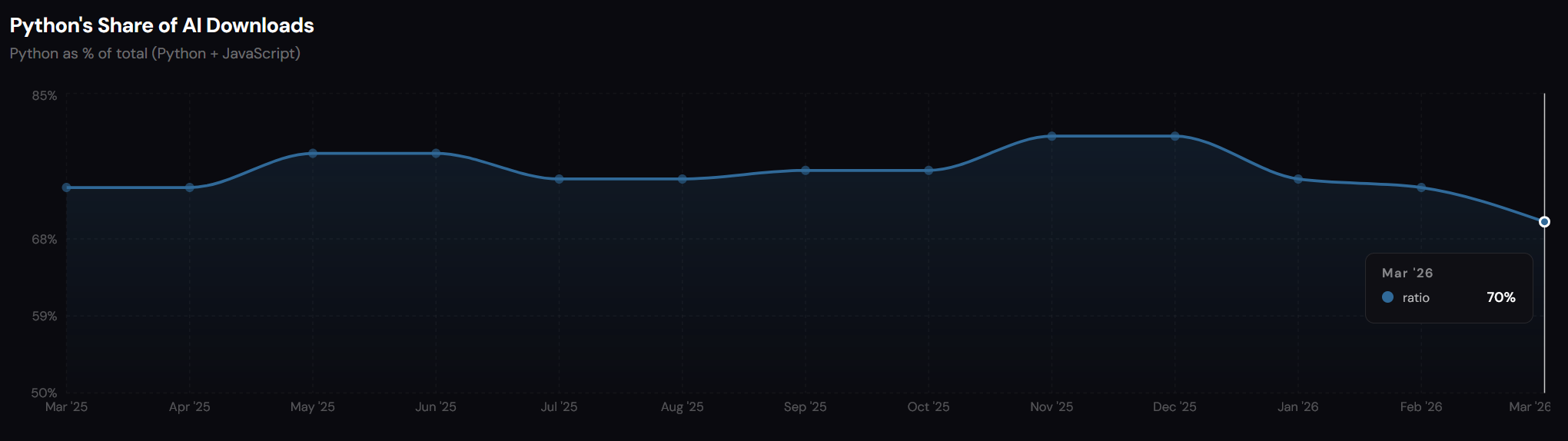
Across the entire dataset, Python accounts for approximately 70% of AI SDK downloads and JavaScript accounts for 30%. This ratio has been remarkably stable, hovering between 70–75% Python share throughout the year with a slight downward trend.
Python's share of total AI SDK downloads dipped from ~74% to ~70% over the year, as JavaScript adoption accelerated slightly faster.
The stability is somewhat surprising. You might expect JavaScript’s share to grow as AI moves from research and data science into production web applications. That shift is happening — JavaScript AI downloads grew 9.4x over the year — but Python grew at a comparable rate, suggesting that the expansion of AI into web development is being matched by continued deepening of AI in Python-native workflows.
What SDK Data Can’t Tell You
It’s important to acknowledge the blind spots. Package downloads measure developer infrastructure adoption — they don’t tell you about end-user satisfaction, revenue, enterprise deal sizes, or which models produce the best outputs.
OpenAI’s ChatGPT has roughly 800 million weekly users and approximately 68% of consumer AI chatbot traffic. Anthropic’s Claude has approximately 19 million monthly users and about 2% of consumer traffic. By that measure, OpenAI is dominant and Anthropic is a niche player.
But the SDK data suggests that underneath the consumer surface, the developer landscape is shifting faster and more dramatically than the consumer numbers would imply. Developers who are building the next generation of AI-powered products are increasingly choosing Anthropic. Those products haven’t reached consumers yet — but they will.
The other major blind spot is that SDK downloads don’t capture usage through cloud platform integrations. Developers using Claude via AWS Bedrock, Gemini via Vertex AI, or GPT-4 via Azure OpenAI won’t show up in pip install counts. Enterprise adoption through these channels is likely substantial and may paint a different picture than the direct SDK data.
Looking Ahead
The March 2026 data shows a market-wide acceleration: every provider posted strong or record growth in the final month of our dataset. The AI developer ecosystem is still expanding rapidly, and the competitive dynamics remain in flux.
A year ago, OpenAI’s SDK dominance seemed unassailable. Today, the picture is more nuanced — a three-way race among the big providers, with the smaller players carving out meaningful niches. The question for the next twelve months isn’t just who grows fastest, but whether the current signals — Anthropic’s developer momentum, Google’s ecosystem leverage, OpenAI’s consumer dominance — translate into durable competitive advantages.
The SDK data will keep telling the story, one pip install at a time.
Data sources: PyPI download statistics, NPM download statistics, and GitHub repository creation data for AI provider SDKs, March 2025 through March 2026.
Explore the Dashboard
The AI SDK Adoption Dashboard is live and interactive. See the data for yourself.