We Analyzed 2,000+ Glassdoor Reviews Across Five Cybersecurity Giants
How we turned three years of employee reviews into an interactive dashboard that reveals what it's really like to work at CrowdStrike, Palo Alto Networks, Fortinet, Zscaler, and SentinelOne.
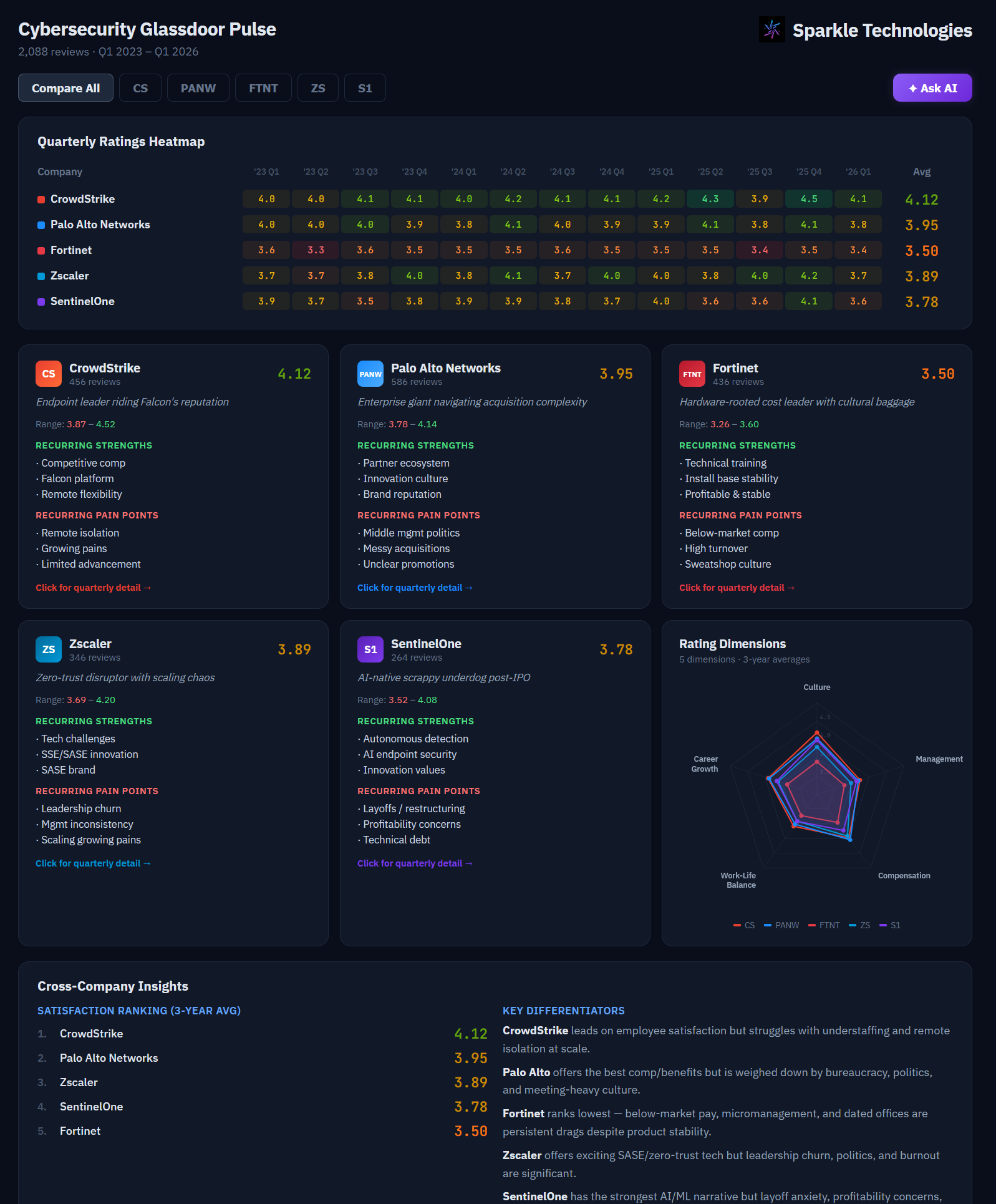
The Compare All view — quarterly heatmap, company cards with recurring strengths and pain points, and a five-dimensional radar chart
Glassdoor ratings get a glance during a job search, maybe a skim during diligence. But there are thousands of data points buried in those reviews — trends, patterns, and signals that surface what it actually feels like to work at a company, quarter by quarter, role by role.
We built the Cybersecurity Glassdoor Pulse to extract that signal. We collected over 2,000 employee reviews spanning three years across five of the largest publicly traded cybersecurity companies — CrowdStrike, Palo Alto Networks, Fortinet, Zscaler, and SentinelOne — and used AI to categorize, quantify, and visualize what employees are actually saying.
The result is an interactive platform that goes far beyond star ratings. It tracks how employee sentiment evolves over time, identifies the specific topics driving satisfaction and frustration, compares companies across dimensions and job functions, and surfaces the most helpful individual reviews. And if the pre-built views don't answer your question, an integrated AI assistant lets you ask anything and get answers — with charts and Excel exports — on the fly.
Average Glassdoor Ratings Over Time
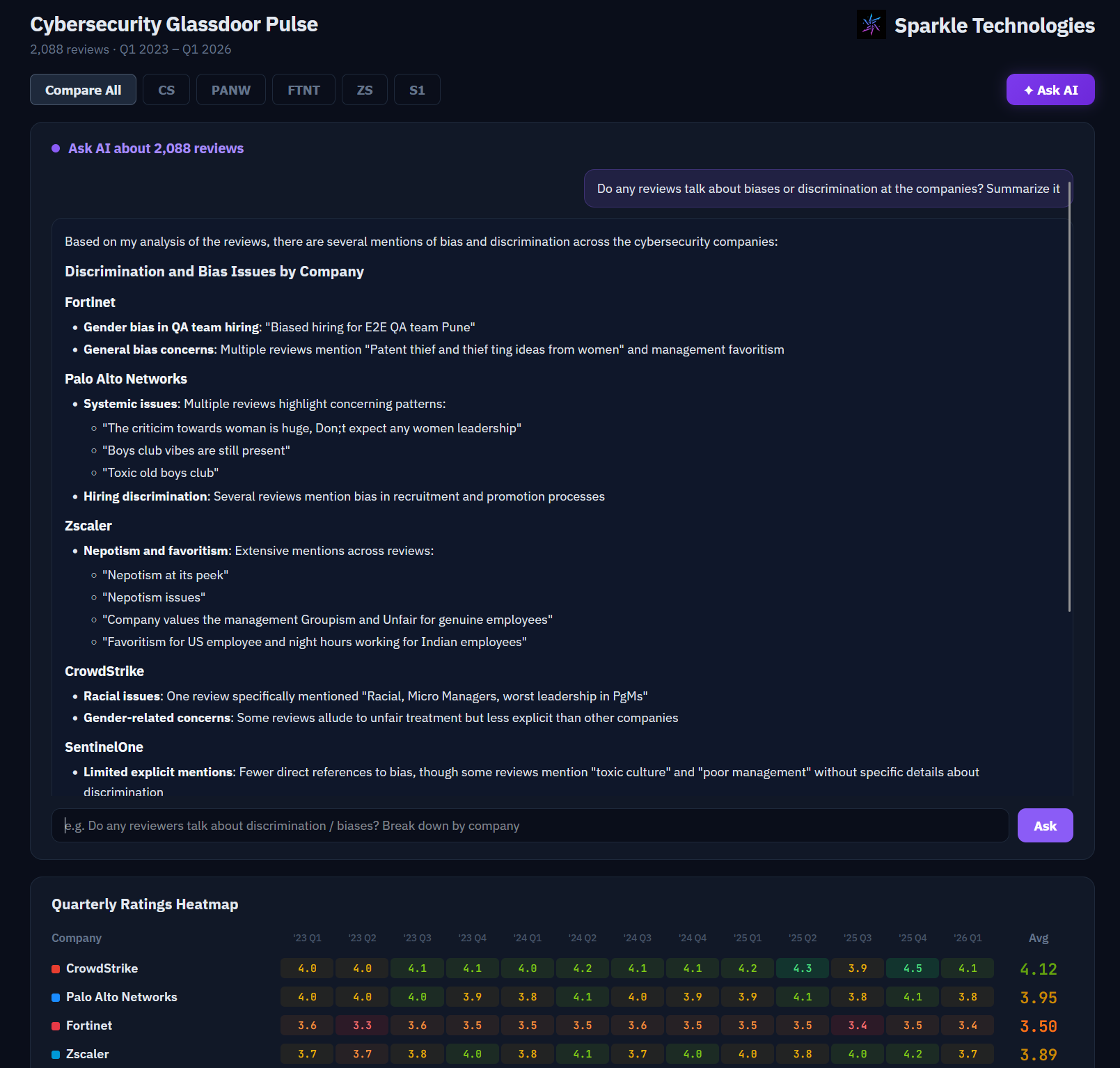
The centerpiece of the Compare All view is a quarterly ratings heatmap. Every company's average Glassdoor rating is displayed for each of the 13 quarters from Q1 2023 through Q1 2026, color-coded from green (high) to red (low). You can see at a glance who is improving, who is stagnating, and who is slipping.
CrowdStrike leads the pack with a 3-year average of 4.12, ranging from a low of 3.87 to a peak of 4.52. Palo Alto Networks sits at 3.95, oscillating in a narrow band that reflects periodic reorg fatigue followed by stabilization. Fortinet consistently brings up the rear at 3.50 — never breaking above 3.60 in any single quarter. Zscaler (3.76) and SentinelOne (3.75) sit in the middle, with more volatile trajectories driven by leadership changes, layoffs, and strategic pivots.
Strengths and Weaknesses: What Employees Actually Talk About
A star rating tells you very little about why employees feel the way they do. A 4.0-rated company might have exceptional technology but terrible management — or great pay but no work-life balance. The aggregate number hides the story.
We used AI to extract and categorize the specific topics employees mention in their pros and cons, then tracked the percentage of reviewers in each quarter who mentioned each topic. The result is a detailed breakdown of what's actually driving sentiment at each company.
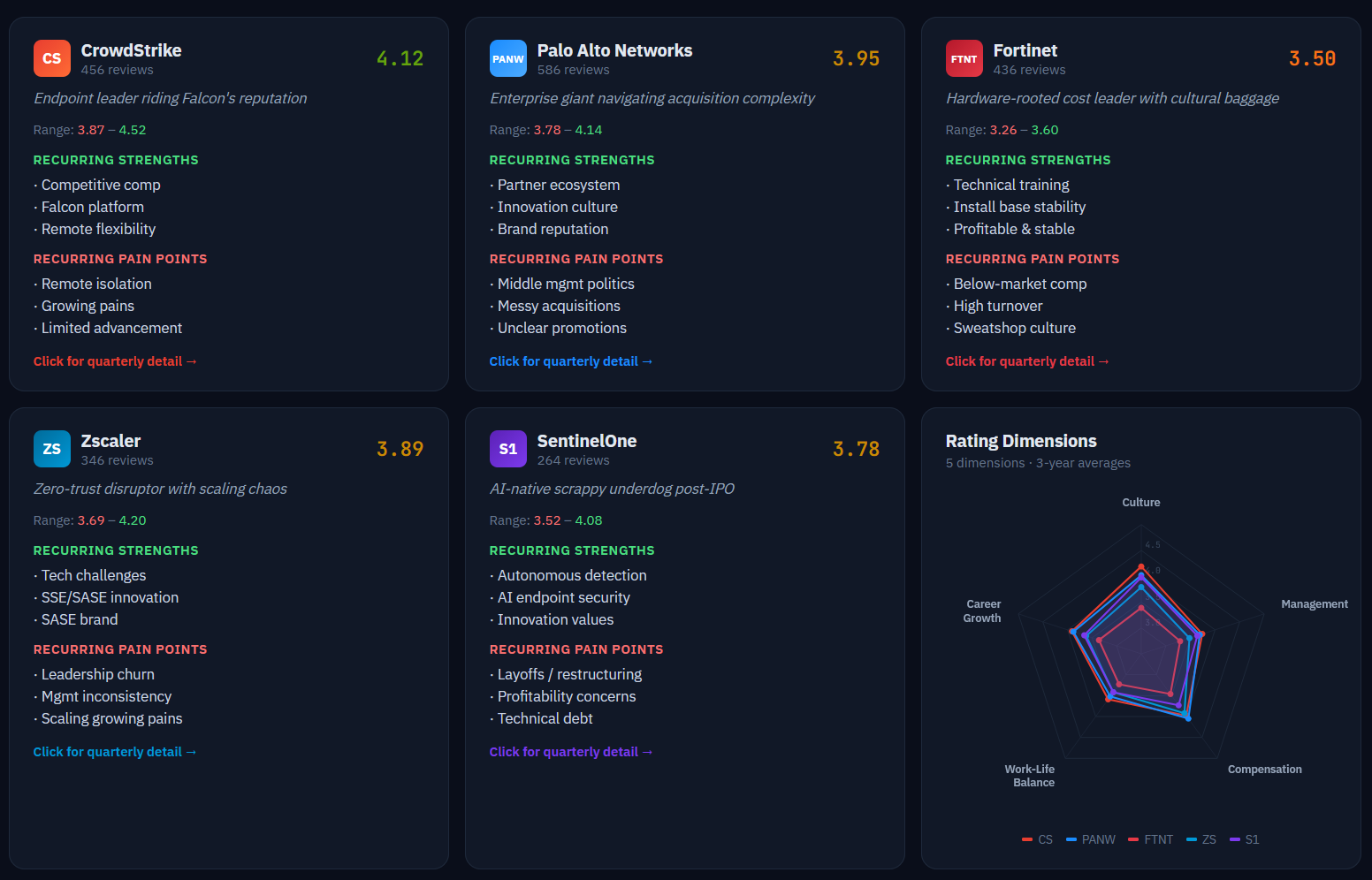
Each company card surfaces the top recurring strengths and pain points extracted from review text
On the Compare All view, every company card surfaces the top three recurring strengths and top three recurring pain points across all 13 quarters. Click into any company and you get the full quarterly breakdown — with the exact percentage of reviewers who mentioned each topic, quarter by quarter.
Company
Top Strength
Top Weakness
CrowdStrike
Falcon platform & engineering talent
Remote isolation & understaffing
Palo Alto Networks
Compensation, brand & platform breadth
Bureaucracy, politics & meeting culture
Fortinet
Stability, SMB dominance & training
Below-market comp & micromanagement
Zscaler
SASE/zero-trust technology & innovation
Leadership churn, politics & burnout
SentinelOne
AI/ML narrative & startup energy
Layoff anxiety & profitability concerns
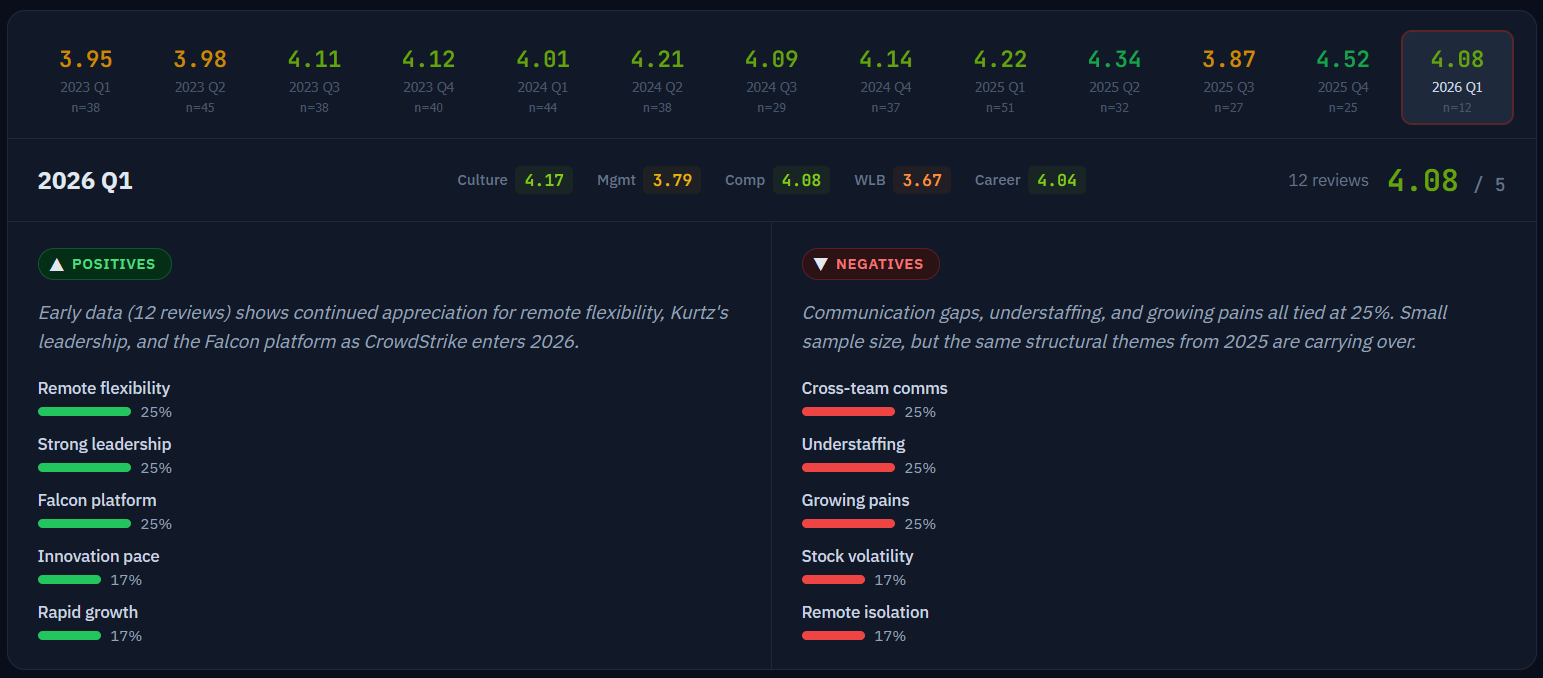
Each quarter's detail panel shows the top five positive and negative topics with bar charts indicating what percentage of that quarter's reviewers mentioned each one. For example, in CrowdStrike's Q4 2025, 32% of reviewers flagged understaffing as a concern — a 3-year high — even as the overall rating hit its peak of 4.52. That kind of nuance is invisible in a star rating but obvious in the topic breakdown.
Key Differences Between Companies
The Cross-Company Insights panel synthesizes the key differentiators extracted from the review text across all five companies. These aren't just summaries of ratings — they're qualitative distinctions that emerge from reading thousands of reviews:
CrowdStrike leads on employee satisfaction but struggles with understaffing and remote isolation at scale. Palo Alto Networks offers the best compensation and benefits but is weighed down by bureaucracy, politics, and a meeting-heavy culture. Fortinet ranks lowest — below-market pay, micromanagement, and dated offices are persistent drags despite product stability. Zscaler offers exciting SASE/zero-trust technology but leadership churn, politics, and burnout are significant. SentinelOne has the strongest AI/ML narrative but layoff anxiety, profitability concerns, and the brand gap versus CrowdStrike keep morale volatile.
Rating Dimensions: A Five-Axis Radar
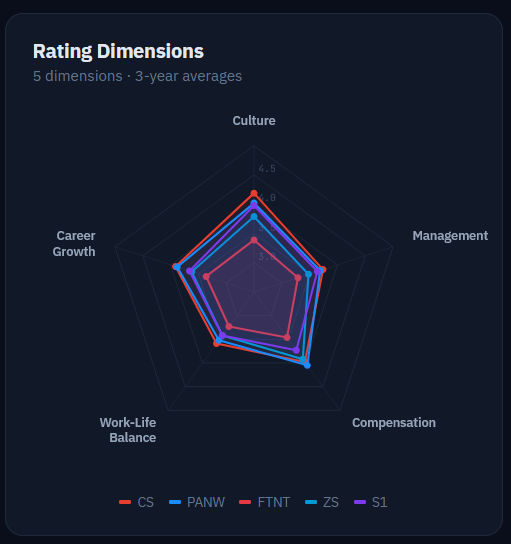
Beyond the overall rating, we break every company's reviews down into five dimensions: Culture, Management, Compensation, Work-Life Balance, and Career Growth. These are displayed as a radar chart on the Compare All view, showing each company's 3-year average across all five axes.
Five rating dimensions plotted across all companies — 3-year averages from Q1 2023 through Q1 2026
CrowdStrike leads on Culture (4.19) and Career Growth (3.91). Palo Alto Networks edges ahead on Compensation (4.05). Fortinet trails on every dimension, with Management (3.29) and Work-Life Balance (3.23) as particular weak spots. The radar makes these relative strengths and weaknesses immediately apparent — and when you drill into each company's detail view, you can see how each dimension changes quarter by quarter.
Ratings by Job Function
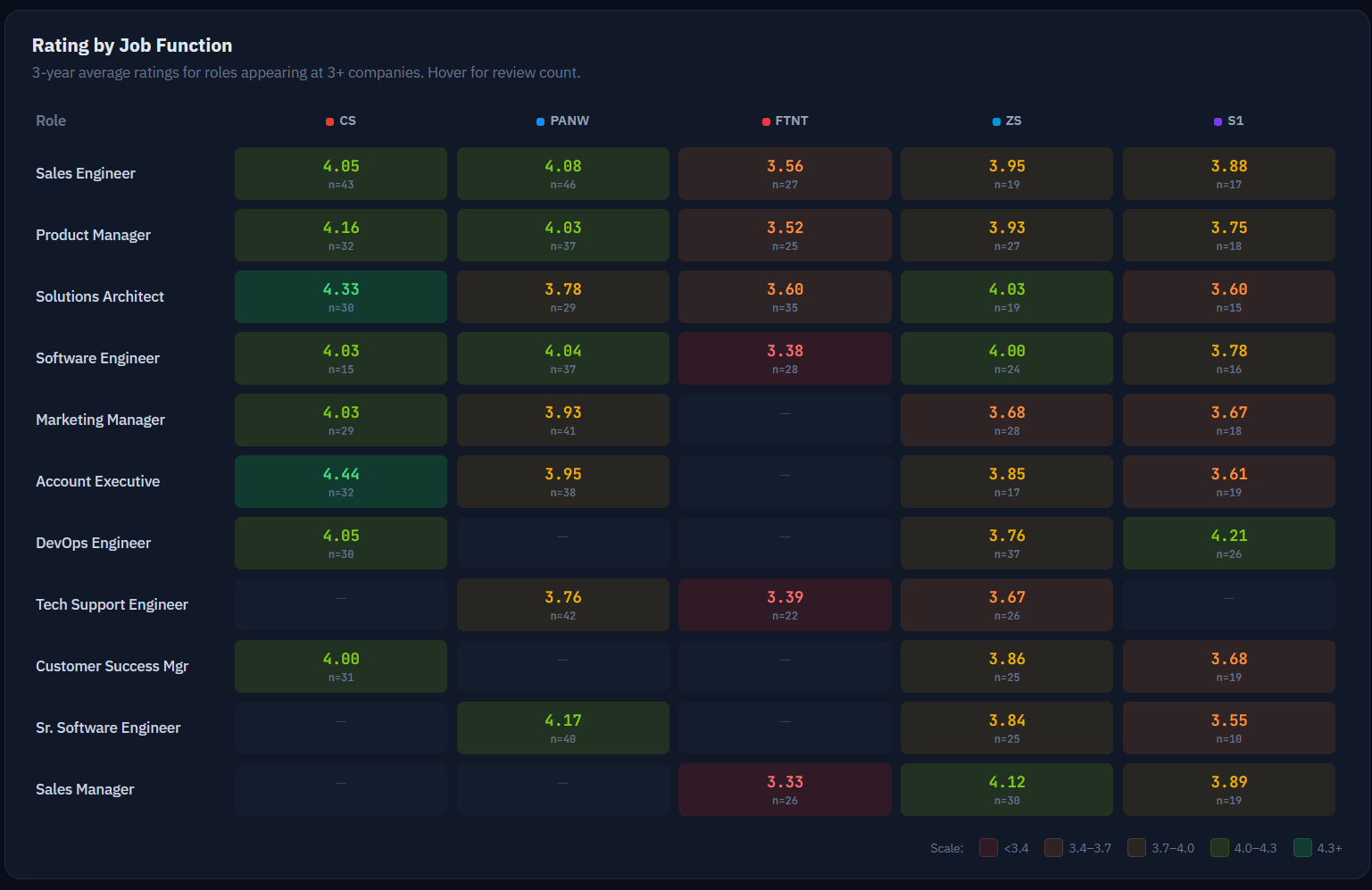
The same company can feel like a completely different workplace depending on your role. A Sales Engineer's experience is nothing like a DevOps Engineer's. We broke out 3-year average ratings by job function, with a cross-company comparison for roles that appear at three or more companies.
Rating by Job Function — 3-year averages for roles present at 3+ companies, color-coded by satisfaction
CrowdStrike's Account Executives are the happiest in the industry at 4.44, while its Solutions Architects lead at 4.33. Palo Alto's Senior Software Engineers rate highest among the engineering roles at 4.17. Fortinet's roles uniformly cluster below 3.70 — with Channel Account Managers and Sales Managers at the bottom (3.33). SentinelOne's DevOps Engineers buck the trend at 4.21 despite the company's overall mid-pack rating.
Within each company's detail view, the full list of 15 job functions is displayed with bar charts and review counts, so you can see exactly how satisfaction varies across the organization.
3-Year Evolution: Each Company's Story
Numbers alone don't capture how a company changes. For each company, we wrote a narrative synthesis — drawn entirely from the review text — that traces the evolution of employee sentiment over the full three-year window.
The 3-Year Evolution panel synthesizes each company's trajectory from the review text
These narratives surface the kind of insight that takes days to develop manually. CrowdStrike entered 2023 averaging 3.95 with employees citing career growth and the Falcon platform — but by 2025, the narrative had shifted toward appreciation for George Kurtz's leadership and fast-paced innovation, while stock comp volatility emerged as a new concern. Palo Alto Networks is "the story of a company treading water" — starting at 3.95 and ending in essentially the same place, with the nature of complaints shifting from high turnover to meeting-heavy culture. Fortinet "barely moved, and not in a good way."
Below each evolution narrative, a quarter timeline lets you click through all 13 quarters. Each quarter panel shows the overall rating, review count, five dimension scores, a written summary of the positives and negatives, and the topic breakdown with exact percentages.
Positive and Negative Topic Prevalence
For every quarter at every company, we track the percentage of employees who wrote about each positive and negative topic. This goes beyond "how many people are happy" to reveal what specifically they're happy or unhappy about — and how those themes shift over time.
Each quarter shows the top 5 positive and negative topics with the exact percentage of reviewers who mentioned them
At CrowdStrike in Q4 2025, 24% of reviewers praised work-life balance and 24% praised engineering talent — but 32% flagged understaffing and 24% flagged burnout risk. At Palo Alto Networks in Q1 2025, 25% of reviewers called out the meeting-heavy culture as their top complaint. At Fortinet, below-market compensation appears in virtually every quarter's top five negatives.
These percentages make it possible to compare not just whether a topic appears, but how prevalent it is across the employee base — and whether it's getting better or worse over time.
Most Helpful Reviews
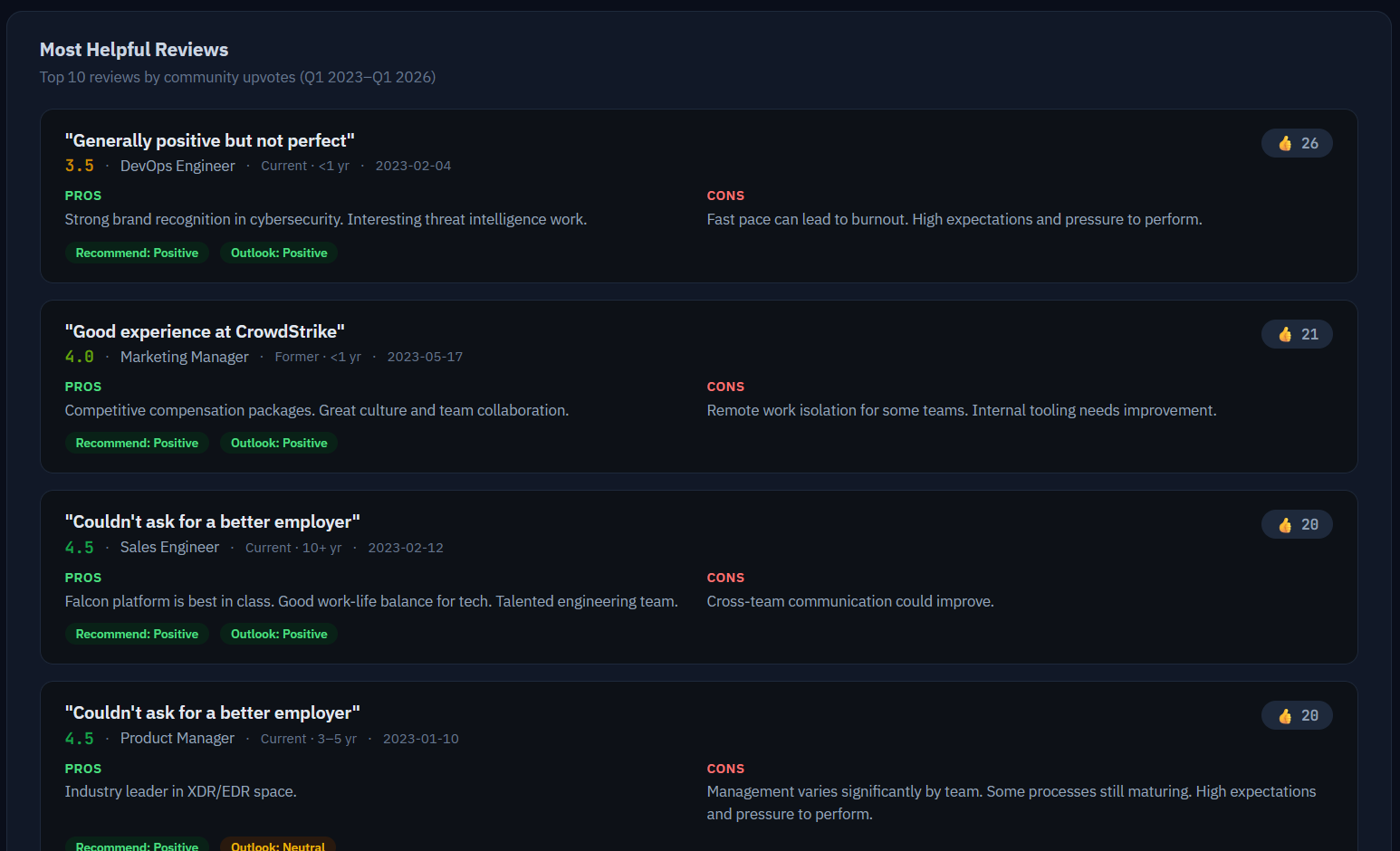
Sometimes the most valuable insight is a single well-written review. For each company, we surface the 10 most helpful reviews — ranked by community upvotes on Glassdoor — from the entire 3-year period.
The 10 most upvoted reviews for each company — with full pros, cons, recommendation, and outlook
Each review card shows the headline, star rating, job title, employment status, tenure, date, and the full pros and cons text. Recommendation and outlook badges are color-coded (green for positive, red for negative, yellow for neutral). The upvote count confirms that other employees found the review useful, giving you confidence that these are the most representative and insightful voices in the data.
For CrowdStrike, the most-upvoted review (26 helpful votes) is from a DevOps Engineer who describes the company as "generally positive but not perfect" — praising brand recognition and threat intelligence work while flagging the fast pace and performance pressure. These individual voices add texture that no aggregate can provide.
Ask AI: Your Own Analyst on Demand
The features above cover the analyses we thought were most important. But every reader has their own questions. That's why we built Ask AI directly into the platform.
Ask AI anything about the 2,000+ reviews — get answers with charts, tables, and Excel exports
Click the "Ask AI" button and a chat panel opens. You can ask any question about the data — trends, comparisons, specific roles, sentiment analysis, custom breakdowns — and get a detailed answer powered by the full review dataset.
Ask AI doesn't just return text. It can generate interactive Plotly charts inline — bar charts, line charts, scatter plots, whatever the question calls for. And if you need the underlying data, it can produce downloadable Excel files directly in the chat, with a preview table so you can see what you're getting before you download.
Think of Ask AI as an analyst who has read every single review and can answer any question in seconds. "Do any reviewers talk about discrimination or bias? Break down by company." "Which roles have the most volatile ratings quarter over quarter?" "Compare compensation satisfaction trends for CrowdStrike vs. Palo Alto." Whatever you're curious about, just ask.
The combination of pre-built analyses and an open-ended AI assistant means the platform isn't limited to the questions we anticipated. It adapts to yours.
Why We Built This
This is part of what we do at Sparkle Technologies. We build sophisticated analytical platforms for hedge funds, private equity firms, and operating companies — the kind of tools that turn unstructured, fragmented data into clear, defensible intelligence. Alternative data pipelines, NLP-powered analysis, interactive dashboards, AI-powered Q&A — we've done it across industries and asset classes.
Employee review data is one of the most underutilized alternative data sources in the market. Every quarter, thousands of employees voluntarily share detailed, written assessments of their employers — covering compensation, culture, management, work-life balance, strategy, and more. Most people glance at the star rating. We read the text.
For our clients, this kind of analysis surfaces signals that move ahead of public data. A persistent decline in engineering satisfaction at a cybersecurity company might foreshadow product quality issues months before they show up in earnings. A spike in "layoff anxiety" across a company's reviews might presage a restructuring announcement. These are the kinds of signals institutional investors are looking for — and we build the tools to find them.
If your firm needs this kind of intelligence — whether it's cybersecurity, SaaS, healthcare, financial services, or any other sector — we'd love to talk about what we can build for you.
Explore the Platform
The Cybersecurity Glassdoor Pulse is live and interactive. See the analysis for yourself.