How to Run an AI Visibility Audit: A 6-Step Framework for the Gaps SEO Audits Miss
Your brand can be #1 on Google and invisible to ChatGPT. Here’s the audit framework that surfaces the gap — the methodology, the tooling at each step, the budget ranges, and the pitfalls.
6
Steps
4
AI Metrics
3
Tooling Tiers
Your brand can be #1 on Google and invisible to ChatGPT. We’ve now seen this pattern often enough to call it a category — dominant organic players who built their entire search presence on product pages and category pages, only to discover that the answer engines competing for the same buyer attention don’t cite them at all. The traditional SEO audit doesn’t catch this. It measures rankings, not citations.
This post is the playbook for the audit that does catch it. The framework is the same one we used in our Content Gap & AI Visibility Analysis for Fast Growing Trees, which surfaced 3,154 keyword gaps, 13 AI prompt gaps where competitors are cited by Google AI Overview and Fast Growing Trees is not, and over $760K in estimated annual impact from closing both. The case study tells the story; this post walks through the methodology, the tooling at each step, the budget ranges, and the pitfalls — everything you’d need to run the same audit on your own brand or hand it off to a team to run for you.
When this audit is worth running
The audit produces the most useful output when the brand has commercial intent queries that AI answer engines are increasingly intercepting. In practice, that’s:
E-commerce brands in informational-heavy verticals (home & garden, health, beauty, fitness, hobby goods — anything where buyers research before purchasing).
B2B brands with mature content marketing programs where SEO is a primary acquisition channel.
Established brands whose organic traffic has plateaued despite continued investment.
Portfolio companies where the brand is the asset — particularly under PE or VC ownership, where flat or declining organic traffic shows up directly in the EBITDA model.
The audit produces less value when there isn’t enough query volume to measure — pre-launch brands with no organic presence yet, or ultra-niche B2B where the buyer’s research happens in private channels rather than against AI. In those cases, the standard playbook (build authority, then audit) still applies.
If you fit the first list, the rest of this post is the framework.
The 6-step framework
The audit breaks into six sequential steps. Steps 1–3 are a traditional content gap analysis. Steps 4–6 are the AI Visibility extension — newer, less standardized, and where the most surprising findings tend to surface.
Step 1 — Domain Metrics Comparison
What it measures. Where your brand sits versus a defined competitive set on the foundational SEO metrics: domain authority, monthly organic traffic, traffic value, total ranking keywords, total backlinks.
Why it’s first. Every downstream step depends on having the right competitor set. If you benchmark against the wrong companies, every gap you find will be misleading.
Tools. Ahrefs, Semrush, or Moz — any of them is sufficient. We typically use Ahrefs for the authority and traffic metrics and cross-check with Semrush for keyword coverage.
Worked example from Fast Growing Trees. 1.4M monthly organic visits, domain authority 56, $796,200/month in traffic value. More than double its nearest competitor on every metric except backlinks. That asymmetry — high authority, lower backlinks — turned out to matter later.
Time budget. 2–4 hours, mostly to pick the competitor set thoughtfully. Don’t just take the tool’s “competitors” tab at face value; cross-check with the brands that actually appear on commercial-intent SERPs in your space.
Common pitfall. Choosing competitors based on industry overlap rather than search overlap. A direct-to-consumer plant nursery and a national landscaping chain might serve the same end market, but if they don’t compete on the same queries, comparing them produces noise.
Step 2 — Keyword Gap Analysis
What it measures. Specific keywords where competitors rank in the top 20 and you don’t (or rank below position 50, which is effectively invisible).
Tools. Ahrefs Content Gap, Semrush Keyword Gap. Both will output a raw list in the tens of thousands. The work is in the filtering, not the extraction.
The filter stack we use.
Search volume > 1,000/month
Keyword difficulty < 60
At least one competitor ranking in the top 20
Commercial or informational intent (exclude navigational and pure brand queries)
Hand-review to drop irrelevant matches the tools surface
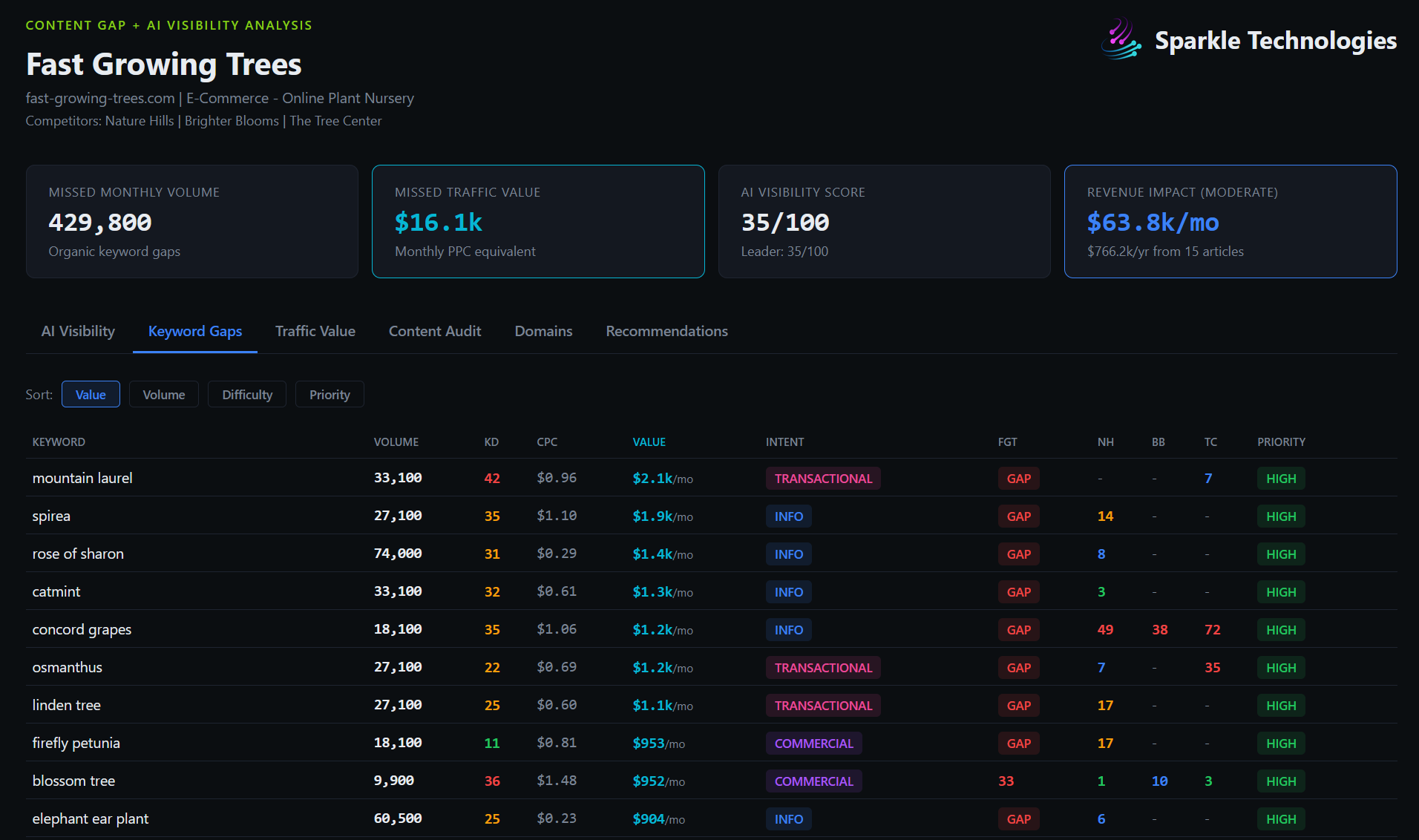
Worked example. Fast Growing Trees: 3,154 raw keyword gaps → 375 after quantitative filters → 25 hand-selected for prioritization, representing 429,800 monthly searches and $16,100/month in traffic value.
Example output from Step 2 — hand-selected keyword gaps representing 429,800 monthly searches.
Time budget. 4–8 hours including hand-review. The hand-review is where the actual judgment happens — automated filters can’t tell you that “plant nursery near me” isn’t a content gap you can close, but “deer resistant shrubs northeast” is.
Common pitfall. Skipping the intent filter. We see audits constantly that surface 5,000 “keyword opportunities” that turn out to include the brand’s own navigational queries, irrelevant geographic variants, or queries that already match an existing page that’s ranking. Cleaning the list is where the analyst earns the fee.
Step 3 — Competitor Content Audit
What it measures. Which specific pages drive the competitor traffic you’re losing, what formats those pages take, and what structural patterns make them work.
Tools. Ahrefs Top Pages, Semrush Pages Report, Screaming Frog for crawling the actual page structure.
What to classify. For each top-traffic competitor page, tag the format: pillar guide, care/how-to guide, comparison page, buyer’s guide, listicle, glossary, product roundup, or product/category page. The format distribution tells you what type of content your competitors are using to win — and where your site is structurally underweight.
Worked example. Fast Growing Trees’ top competitor, Nature Hills, was driving 97,352 visits per month from just its top six blog posts. Fast Growing Trees had no competing content for 10 of the 17 top competitor blog posts we analyzed. Where they did have a page, it ranked beyond position 50.
Time budget. 6–10 hours, depending on how many competitors and how deep you go.
Common pitfall. Only looking at the top 10 pages per competitor. The long tail — pages ranked 20–100 by traffic — often reveals the most repeatable content patterns. A competitor that wins one viral post is a fluke; a competitor that wins 40 care guides is a system.
Step 4 — AI Visibility Analysis
This is the new part of the framework, and the longest section of any AI Visibility audit. The other steps measure where you’re losing in Google’s traditional results. This step measures something different: where you’re absent from the AI-generated answers that increasingly sit above those results.
Why the distinction matters. When someone types “best shrubs for shade” into Google and gets organic results, they choose which link to click. When they ask the same question to ChatGPT, Claude, Perplexity, or Google’s AI Overview, they get a synthesized answer that cites specific sources. The sources that get cited get the traffic. The ones that don’t — regardless of organic ranking — are bypassed entirely.
The four metrics we track.
AI Visibility Score — A 0–100 composite measuring overall presence in AI-generated results across a defined prompt basket.
Total Mentions — How often the brand is referenced in AI responses, with or without a link.
Total Citations — How often the domain is linked as an authoritative source.
Cited Pages — Number of unique pages from the domain that AI platforms cite.
The most important insight in this entire framework. There is a critical difference between AI mentions and AI citations. Mentions mean AI knows your brand. Citations mean AI trusts your content enough to recommend it. Most dominant organic brands have plenty of the first and very little of the second — a direct consequence of having built their organic presence on product and category pages rather than informational content. AI platforms cite informational content. If you don’t have it, you don’t get cited, regardless of how much domain authority you’ve accumulated.
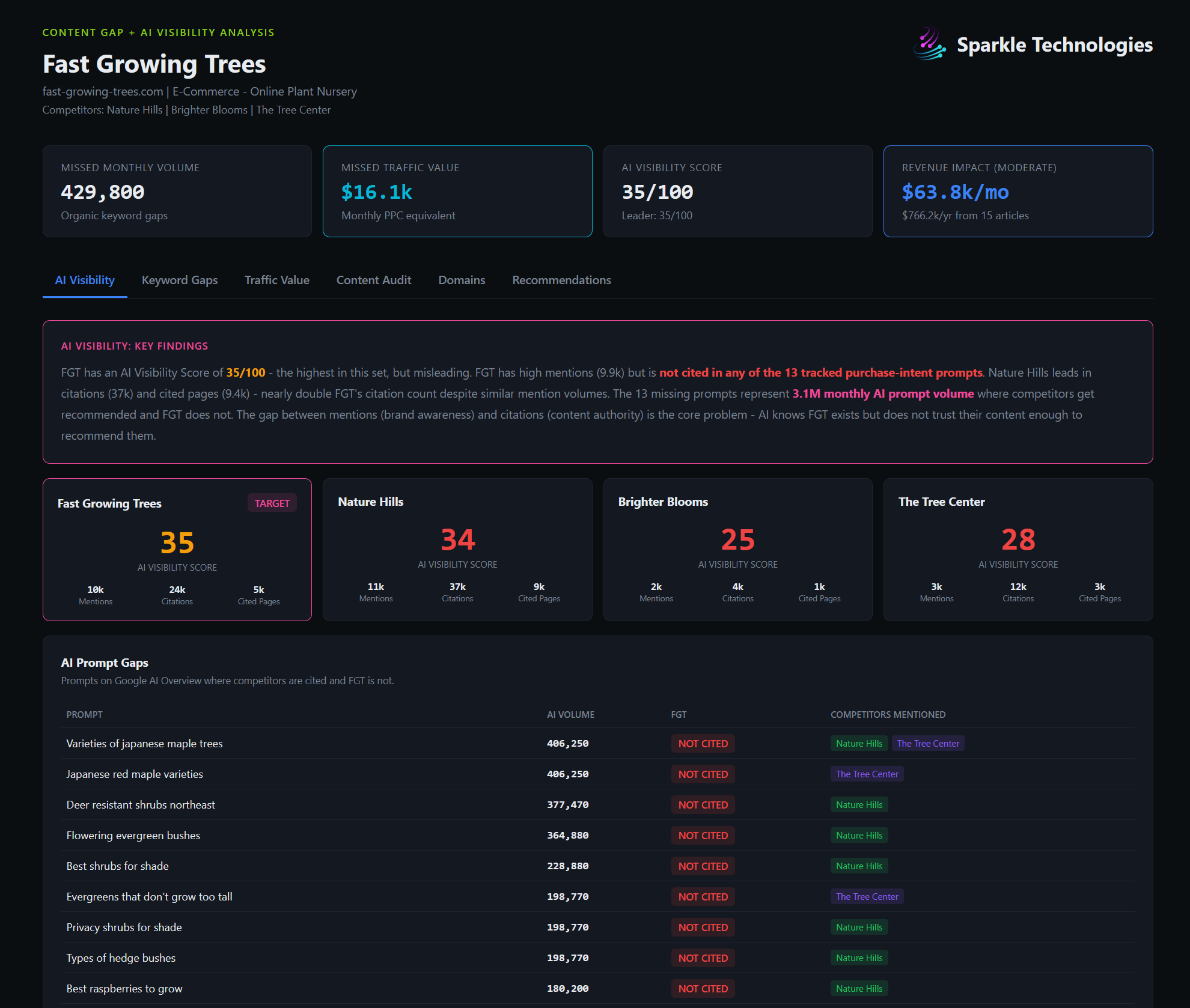
Worked example. Fast Growing Trees had the highest AI Visibility Score in its competitive set (35/100) and 9,900 mentions across our prompt basket. But it had only 23,600 citations — versus Nature Hills’ 37,000 citations and nearly double the cited pages (9,400 vs. 5,100). On the surface, Fast Growing Trees looked like the AI winner. Once we separated mentions from citations, the gap was obvious.
The Step 4 output — AI Visibility scored across four metrics, with the mentions-vs-citations gap visible.
Tooling tiers.
DIY stack. Build a prompt basket of 50–500 high-intent queries. Run each through the ChatGPT, Claude, Perplexity, and Google AI Overview APIs (or scraped equivalents where APIs aren’t available). Parse the responses for brand mentions and cited URLs. Score domains against the four metrics above. Total cost: ~$100–$300 in API calls, plus the engineering time to build the harness.
Mid-tier paid tools. Profound, Athena, Otterly, Peec AI — purpose-built AI visibility platforms that run continuous benchmarks across the major answer engines. Pricing typically lands in the $500–$2,000/month range. Faster to stand up than DIY; less flexibility on prompt curation.
Enterprise / consulting. Custom dashboard, curated prompt basket specific to your buyer journey, quarterly re-runs, integration with your existing BI stack. Engagement-based pricing.
How to build the prompt basket. This is where audit quality lives or dies. A generic prompt basket — “best products in [category]” repeated 50 ways — will produce generic findings. The high-leverage prompts are the ones that match the actual research questions your buyers ask before purchase. We typically build the basket by:
Pulling the top informational queries from the keyword gap analysis (Step 2)
Rewriting them as natural-language questions a buyer would type into ChatGPT
Adding comparison prompts (“X vs. Y for [use case]”)
Adding decision prompts (“how do I choose a [product] for [situation]”)
For Fast Growing Trees, we curated 13 high-intent prompts where competitors are cited by Google AI Overview and Fast Growing Trees is not, representing roughly 3 million monthly AI-mediated impressions across queries like “varieties of japanese maple trees” and “best shrubs for shade.”
Time budget. 12–25 hours for the DIY approach, depending on prompt basket size and how many engines you benchmark across. 4–8 hours with a paid tool.
Common pitfall. Optimizing for ChatGPT and ignoring Google AI Overviews. They cite differently. ChatGPT leans toward content with high topical authority and clear structure. Google AI Overviews lean toward content that already ranks in the traditional top 10 and has schema markup. A brand can be invisible in one and well-cited in the other. Measure both.
Step 5 — Revenue Impact Modeling
What it measures. Translates the keyword gaps and AI prompt gaps into estimated revenue, modeled across conservative, moderate, and optimistic scenarios.
The traditional keyword model.
Estimated traffic capture = search volume × click-through rate at target position
Conversion = traffic × site conversion rate
Revenue = conversion × average order value × repeat purchase factor
The AI side is messier because the click-through behavior from an AI Overview citation is genuinely under-measured. We model AI-mediated revenue as a separate stream with wider scenario bands:
Conservative: AI Overviews intercept 20% of relevant query volume; citation CTR is 10% of traditional organic CTR
Moderate: 40% interception; citation CTR is 30% of traditional CTR
Optimistic: 60% interception; citation CTR is 50% of traditional CTR
Worked example. Fast Growing Trees: $760K+ in estimated annual impact from closing both the keyword and AI prompt gaps, blended across scenarios.
Time budget. 4–8 hours, depending on how much data you have on existing conversion rates and AOV.
Common pitfall. Single-point estimates. The AI citation traffic layer is moving fast enough that any point estimate will be wrong within a quarter. Always model in scenario bands and label assumptions explicitly. The audit’s value is showing the shape of the opportunity, not predicting the exact number.
Step 6 — Content Recommendations
What it produces. A prioritized list of specific articles that close keyword and AI prompt gaps simultaneously, with format guidance and structural recommendations.
The dual-gap principle. The highest-leverage content is the article that ranks for a high-volume keyword AND gets cited by an AI Overview for a related prompt. These aren’t independent goals — most of the time, the same article serves both, but only if it’s structured for AI citation as well as for traditional ranking.
What citation-optimized content looks like.
Clear question-and-answer structure with explicit headers (“What is X?”, “How do I choose X?”)
Dense use of specific entities (named varieties, brands, models, certifications)
High statistic density — AI platforms cite content with concrete numbers more than content with general claims
Defined-list formats for “best of” and “types of” queries
Schema markup (FAQPage, Article, HowTo) — table stakes for Google AI Overview citation
Format recommendations by gap type.
Comparison queries (“X vs Y”) → side-by-side comparison pages with explicit tables
Variety/types queries (“varieties of Japanese maples”) → pillar guides with named sub-types
Buyer’s guide queries (“how to choose a Y”) → decision-tree style articles
Care/how-to queries → step-by-step guides with numbered headers
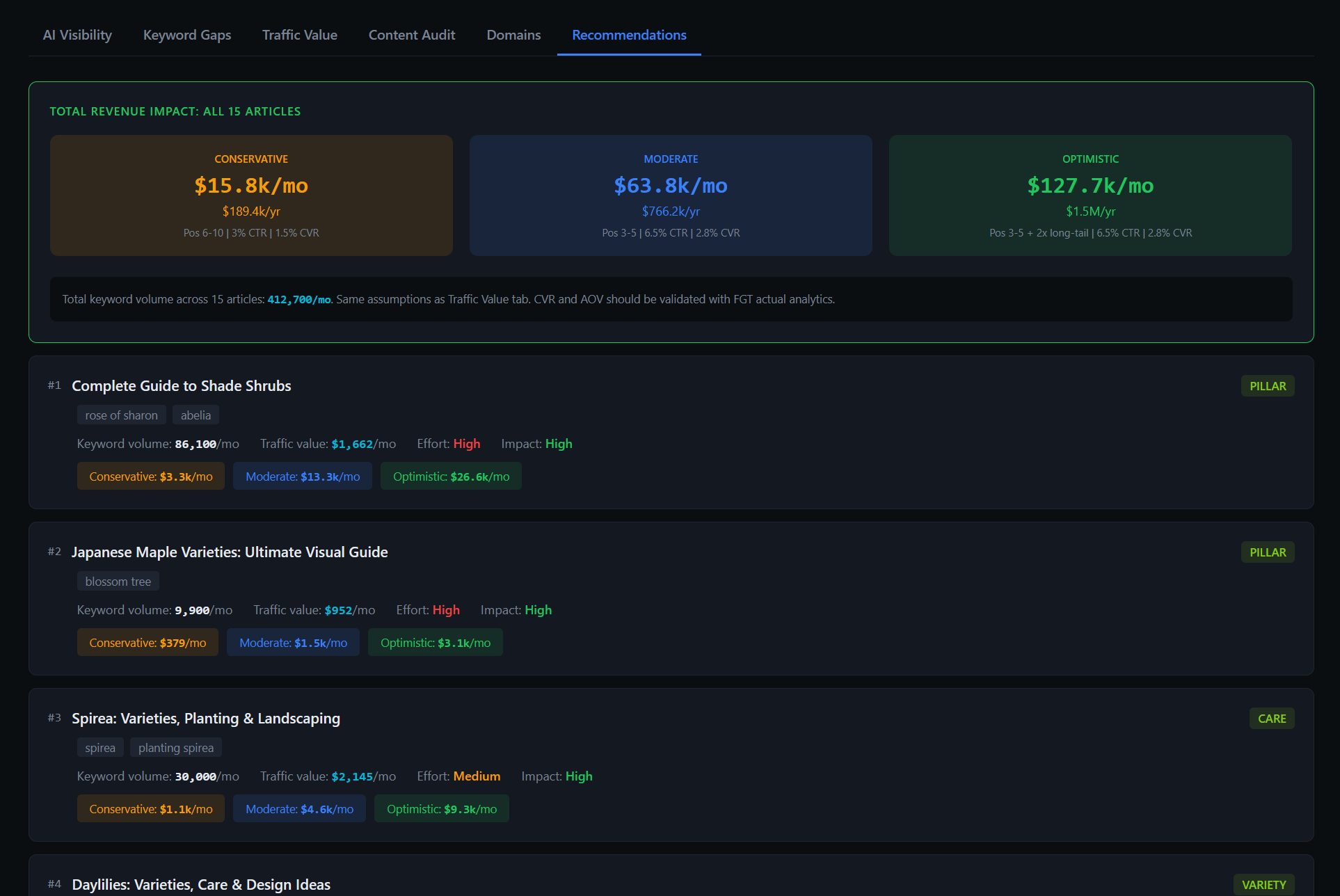
Worked example. For Fast Growing Trees, we delivered 25 specific article recommendations, each tagged to (a) the keyword gap it closes, (b) the AI prompt it targets, (c) the format we recommended, and (d) the priority based on combined search and AI volume.
Time budget. 8–15 hours, including the writing prompts or briefs for each recommended article.
Common pitfall. Recommending the article topics without specifying the structure. A brief that says “write a guide to deer-resistant shrubs” produces a 1,500-word article. A brief that says “write a guide to deer-resistant shrubs with a 12-variety comparison table, regional sub-sections for the Northeast/Midwest/Southwest, and a decision-tree on full-sun vs. partial-shade selection” produces an article that gets cited.
Step 6 output — each recommendation tagged to the keyword gap and AI prompt it closes.
Tooling and budget
Here’s the honest range for running this audit, from cheapest to most thorough.
Minimum viable stack
Ahrefs or Semrush subscription (~$200/mo)
ChatGPT API + Claude API for the AI Visibility step (~$100–$300 in run cost)
A spreadsheet
~40 hours of analyst time
Total cost: ~$1,000 if you have the analyst time in-house, plus the SEO tool subscription you’re probably paying for already.
What you give up: Ongoing measurement. The audit is a snapshot. Without a paid tool or a custom harness, you’d need to rerun the whole thing manually each quarter.
Mid-tier stack
Ahrefs + a paid AI visibility tool (Profound, Athena, Otterly) — ~$1,000–$2,500/mo
~25 hours of analyst time
Faster turnaround, lower judgment requirement
Total cost: ~$3,000–$5,000 for the one-time audit, plus the recurring tool cost if you want ongoing tracking.
What you give up: Some flexibility on prompt curation — paid tools have their own prompt baskets, which may or may not match your buyer journey.
Engagement / consulting
Curated competitor set and prompt basket specific to your business
Custom dashboard built around your KPIs
Revenue model tied to your actual conversion data
Quarterly re-runs with trend analysis
Total cost: Typically $8K–$25K for a one-time audit, scaling with competitive set size and prompt basket depth. Ongoing tracking adds on top.
Common pitfalls
Five mistakes we see most often when teams run this without an experienced hand:
Treating AI Visibility as a separate channel from SEO. They’re linked. The signals that drive AI citations — domain authority, structured content, schema markup, backlink quality — are the same signals that drive traditional rankings. A brand that fixes its content gap will see compound returns across both channels. A brand that only optimizes for AI citation patterns in isolation tends to underinvest in the foundational SEO that makes any of it work.
Optimizing for ChatGPT and ignoring Google AI Overviews. They cite differently. ChatGPT favors structured authority. Google AI Overviews favor content that already ranks. Most brands underestimate how different the two surface areas are.
Conflating mentions with citations. The headline AI Visibility Score is misleading on its own. Always look at the citation count and the cited-pages count, because mentions only tell you whether the model knows your brand exists.
Skipping the competitor set step. Every downstream finding inherits the quality of the competitor list. Spend the four hours up front.
Running the audit once. AI Overview coverage is climbing on a quarter-over-quarter basis. The gaps you find today won’t be the same gaps in six months. The audit is most useful as a baseline against which you measure ongoing investment, not as a one-time deliverable.
DIY vs. hire
If you have a senior in-house SEO or analytics lead, plus an analyst with the time, the audit is runnable internally. The methodology above is the complete framework. What we typically see when clients try this internally:
Steps 1–3 (the traditional content gap portion) go well — these are tasks SEO teams already do
Step 4 (AI Visibility) is where most internal teams stall. Either they don’t have the engineering bandwidth to build the prompt harness, or they buy a paid tool and accept its prompt basket without curation
Step 5 (revenue modeling) is often skipped or kept implicit, which makes the audit harder to use as a budgeting input
Step 6 (content recommendations) ends up as a list of topics rather than a list of structured briefs
Where outside help compounds in value: prompt-basket curation (the difference between a generic and a high-signal AI Visibility measurement), scenario-band revenue modeling, and the ongoing benchmarking infrastructure that turns the audit from a one-time snapshot into a measurement system.
This is the work we do at Sparkle Technologies. If you want to see what the full output looks like, the Fast Growing Trees case study walks through the actual analysis end-to-end, and the interactive dashboard shows the format we typically deliver in.
The bigger picture
AI Overviews now appear on a meaningful and growing share of commercial and informational queries. Each time one does, the citations within it become the primary traffic drivers, and the traditional organic results get pushed further down the page. The brands that get cited are the brands whose content was structured for citation — which mostly means brands that invested in informational content, schema, and topical authority before the answer engines arrived.
That investment compounds. The brands that close their content gap and their AI prompt gap simultaneously over the next 12 months will be cited disproportionately by the answer engines for the next several years, because the answer engines have inertia in their citation patterns. The brands that wait will be looking at the same audit a year from now with twice as many gaps and competitors who have moved further ahead.
Want us to run this on your brand?
The first conversation is free, and we can usually tell you within 30 minutes whether your situation is a strong fit for the audit or whether your investment is better spent elsewhere.