Content Gaps, AI Visibility, and the Shift in How People Search
We ran a Content Gap & AI Visibility Analysis for Fast Growing Trees and found something worth writing up: a dominant player, invisible to AI. Here’s what the data showed and why the AI Visibility dimension is becoming as important as traditional keyword analysis.
Content gap analysis has traditionally been about keywords: find the ones competitors rank for, write content to close the gap, capture the traffic. That playbook still works. But an additional dimension is becoming harder to ignore. As more people use AI to research purchases — asking ChatGPT, Google AI Overview, or Perplexity instead of scrolling through search results — a new kind of visibility gap has emerged. One that traditional keyword analysis doesn’t capture.
We recently completed a Content Gap & AI Visibility Analysis for Fast Growing Trees — an online plant nursery that dominates its space in traditional organic search but is almost entirely invisible to AI platforms. The analysis surfaced a structural gap: Fast Growing Trees had the domain authority, the traffic, and the products, but lacked the informational content that AI platforms cite when answering purchase-intent questions.
This post walks through the full analysis. We’ll spend extra time on the AI Visibility piece, since it’s the newer and less well-understood part of the framework — and the part where the findings were most striking.
What is a Content Gap & AI Visibility Analysis?
Our analysis follows a six-step framework:
Domain Metrics Comparison — Benchmark your site against direct competitors on authority, organic traffic, traffic value, keywords, and backlinks.
Keyword Gap Analysis — Find keywords where competitors rank and you don’t (or rank poorly). Filter for volume, difficulty, and commercial relevance.
Competitor Content Audit — Identify the specific content pages driving traffic for your competitors. Understand what formats work (pillar guides, care guides, comparisons, buyer’s guides).
AI Visibility Analysis — Measure how often AI platforms mention, cite, and link to your domain versus competitors. Identify the specific AI prompts where competitors are recommended and you aren’t.
Revenue Impact Modeling — Translate keyword gaps and AI prompt gaps into estimated revenue across conservative, moderate, and optimistic scenarios.
Content Recommendations — Produce specific article recommendations that close both keyword gaps and AI prompt gaps simultaneously.
Steps 1–3 are what most SEO agencies would consider a standard content gap analysis. Steps 4–6 extend the framework to account for AI-mediated search, which is where the more novel findings tend to surface.
The traditional keyword analysis still matters
Let’s start with the foundation. Fast Growing Trees — the dominant organic player in the online plant nursery space — had 1.4 million monthly organic visits, a domain authority of 56, and a traffic value of $796,200 per month. More than double its nearest competitor on every metric except backlinks.
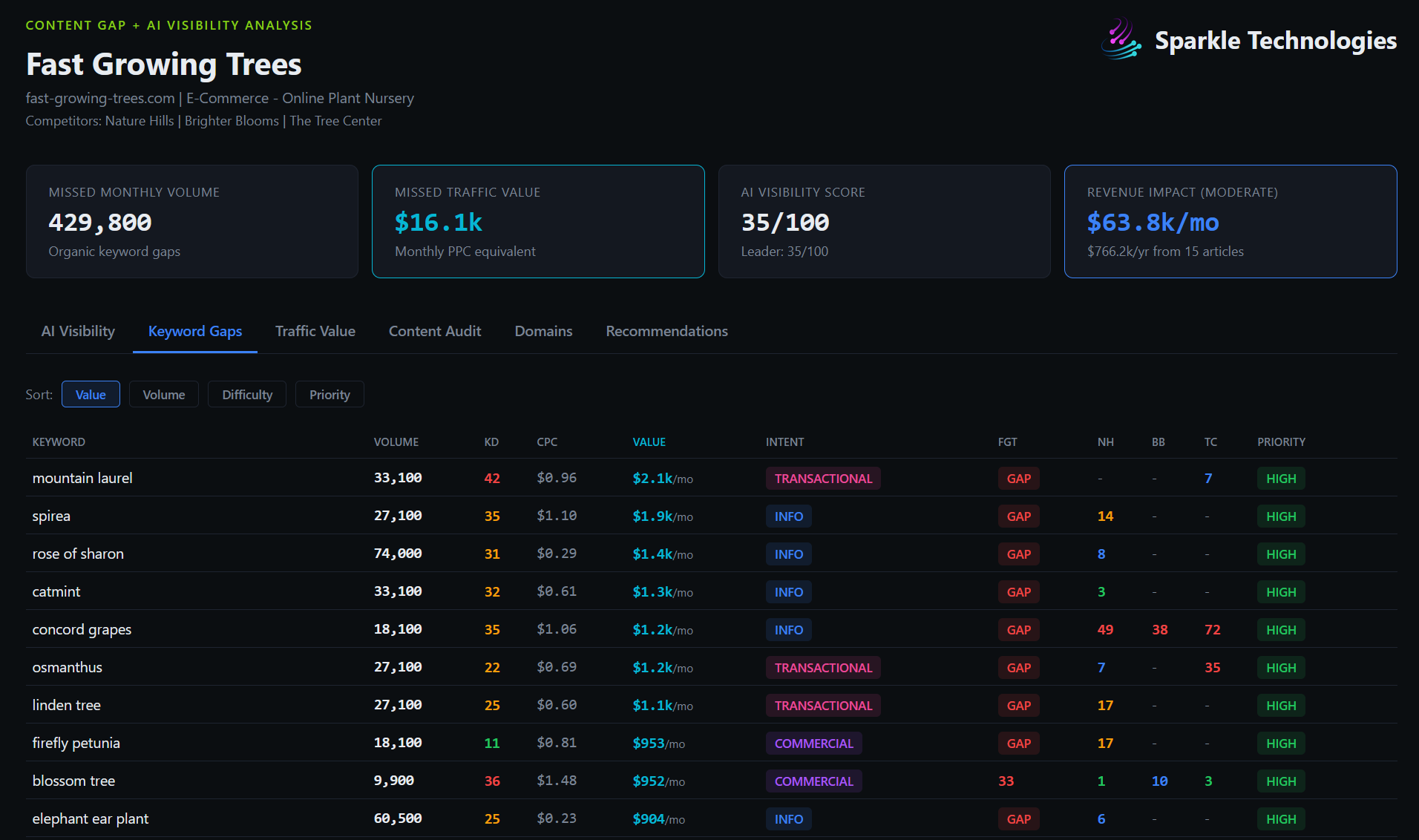
And yet: we identified 3,154 keyword gaps where competitors rank and Fast Growing Trees does not. After applying quality filters (volume > 1,000, keyword difficulty < 60, at least one competitor in the top 20), we narrowed to 375 qualified opportunities and hand-selected 25 representing 429,800 monthly searches and $16,100/month in traffic value.
25 high-priority keyword gaps — 429,800 monthly searches where Fast Growing Trees has no presence but competitors rank.
The pattern was clear: Fast Growing Trees had built its entire organic presence on product pages and collection pages, with almost no investment in informational content. No blog posts, no guides, no how-to articles. Competitors with far less domain authority were capturing tens of thousands of monthly visits through content Fast Growing Trees simply hadn’t created.
Nature Hills, the closest competitor, was driving 97,352 visits per month from just its top six blog posts alone. Fast Growing Trees had no competing content for 10 of the 17 top competitor blog posts we analyzed. Where they did have a page, it ranked 50+ — effectively invisible.
This is a classic content gap story, and the playbook to close it is well-understood: create comprehensive, authoritative content targeting these keywords, and the domain authority advantage does the rest. Fast Growing Trees doesn’t need to build authority from scratch — it already has the highest authority score in the competitive set. It just needs to deploy content against that authority.
But the keyword analysis only told half the story.
The AI Visibility gap
Traditional keyword analysis measures where a domain is losing in Google’s organic results. AI Visibility analysis measures something different: where a domain is absent from the AI-generated answers that are increasingly appearing above those organic results.
The distinction matters because the user behavior is different. When someone types “best shrubs for shade” into Google and gets a list of results, they choose which link to click. When they ask the same question to ChatGPT or Google’s AI Overview, they get a synthesized answer that cites specific sources. The sources that get cited get the traffic. The ones that don’t, regardless of their organic ranking, are bypassed entirely.
This is already happening at meaningful scale, and the share of queries that trigger AI-generated answers continues to grow.
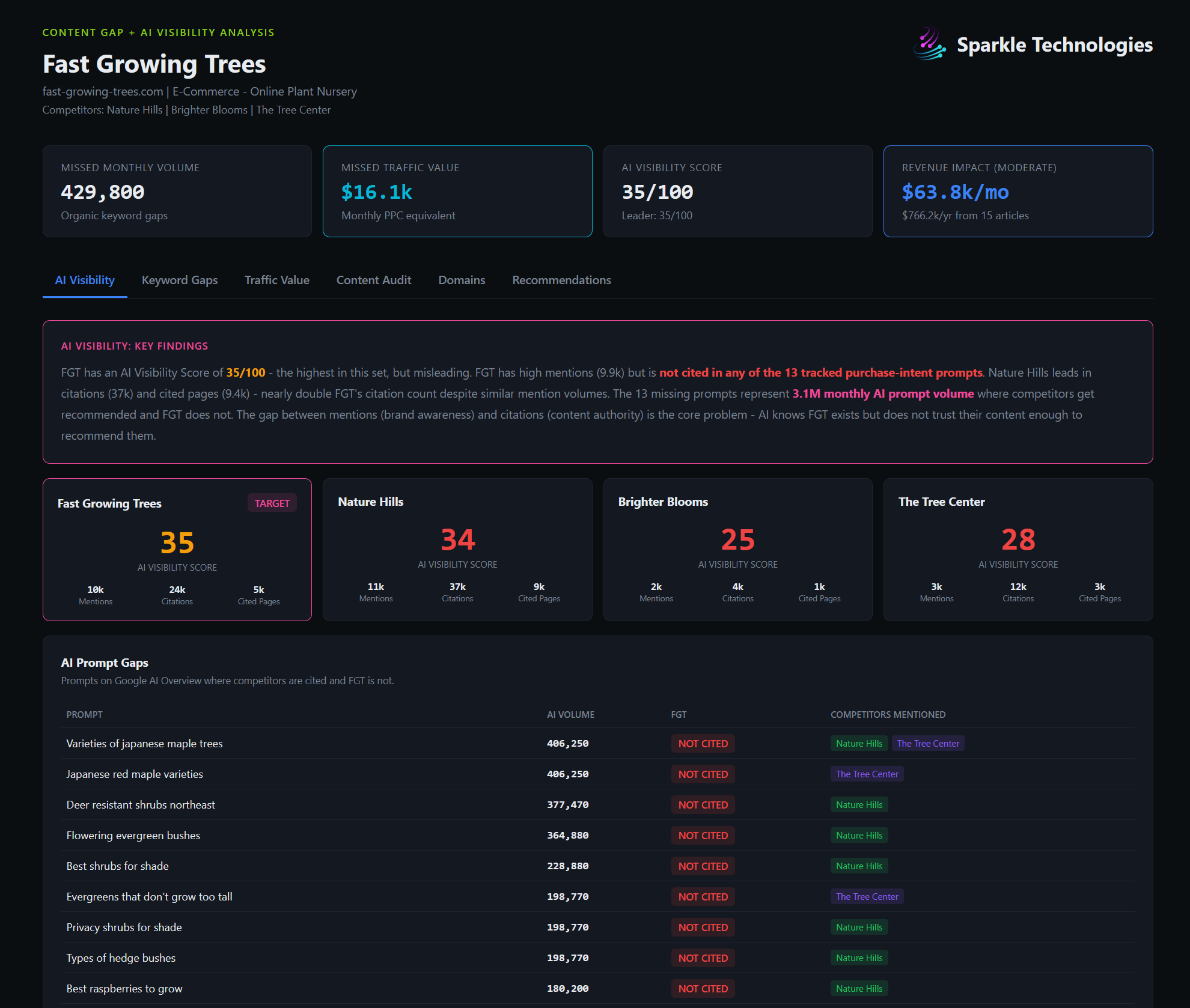
AI Visibility comparison — Fast Growing Trees leads on score but trails badly on citations and cited pages.
In this analysis, we measured four AI Visibility metrics for each domain:
AI Visibility Score — A 0–100 score measuring overall presence in AI-generated results.
Total Mentions — How often the brand is referenced in AI-generated responses.
Total Citations — How often the domain is linked as an authoritative source in AI responses.
Cited Pages — Number of unique pages from the domain that AI platforms cite.
Fast Growing Trees’ AI Visibility Score of 35/100 was the highest in the competitive set. But this headline number turned out to be misleading. They had 9,900 mentions — meaning AI platforms reference the brand — but only 23,600 citations. Nature Hills, with less overall organic traffic, had 37,000 citations and nearly double the cited pages (9,400 vs. 5,100).
The core insight: There is a critical difference between AI mentions and AI citations. Mentions mean AI knows your brand. Citations mean AI trusts your content enough to recommend it. Fast Growing Trees has brand awareness in AI but not content authority in AI — a direct consequence of having no informational content for AI to cite.
Why this gap matters more every quarter
The share of search queries that trigger an AI-generated answer (Google AI Overview, Bing Copilot, ChatGPT search) has been climbing steadily. For commercial and informational queries in verticals like home & garden, AI Overviews now appear on a significant and growing percentage of searches. Each time one does, the traditional organic results get pushed further down the page — and the citations within the AI answer become the primary traffic drivers.
The implication is that the relative importance of AI Visibility versus traditional keyword rankings is shifting. A content strategy that only optimizes for organic rankings is leaving an increasingly large channel unaddressed — one where competitors with informational content are already being cited.
The 13 AI prompts where Fast Growing Trees doesn’t exist
We used AI prompt gap tools to identify specific high-intent prompts where competitors are cited by Google AI Overview and Fast Growing Trees is not. We curated 13 prompts most relevant to purchasing decisions:
AI Prompt
AI Volume
Competitor Cited
Varieties of japanese maple trees
406,250
Nature Hills, The Tree Center
Japanese red maple varieties
406,250
The Tree Center
Deer resistant shrubs northeast
377,470
Nature Hills
Flowering evergreen bushes
364,880
Nature Hills
Best shrubs for shade
228,880
Nature Hills
Evergreens that don’t grow too tall
198,770
The Tree Center
Privacy shrubs for shade
198,770
Nature Hills
Types of hedge bushes
198,770
Nature Hills
Best raspberries to grow
180,200
Nature Hills
Miniature trees for front yard
165,960
Brighter Blooms
Small trees for planting close to house
165,960
Nature Hills
Types of redbud trees
117,340
Nature Hills
Peach varieties list
44,280
Nature Hills
Zero of 13. The dominant organic player in the space, with the highest domain authority and the most traffic, is not cited in a single one of these high-intent AI prompts. Meanwhile, Nature Hills — a competitor with less than half the traffic — is cited in 9 of 13.
Why? Because Nature Hills has the blog content. When someone asks AI “what are the best shrubs for shade?”, AI doesn’t cite a product page. It cites the guide, the care article, the pillar post that comprehensively answers the question. Product pages answer “what can I buy?” Informational content answers “what should I buy?” — and that’s the question AI is responding to.
Closing both gaps at once
One of the more useful findings from this analysis is that the same content that closes keyword gaps also closes AI prompt gaps. These are not two separate content strategies — they converge. A single piece of well-structured informational content serves both the traditional organic channel and the AI citation channel.
A comprehensive guide to shade shrubs, for example, targets the keyword “rose of sharon” (74,000 monthly searches) and “abelia” (12,100 monthly searches) for traditional SEO. The same guide also addresses three AI prompt gaps where Nature Hills is currently cited: “best shrubs for shade,” “privacy shrubs for shade,” and “types of hedge bushes.” One piece of content, two distribution channels.
We developed 15 article recommendations using this dual-targeting approach. Each recommendation maps specific gap keywords and AI prompt gaps to a content format, with per-article revenue projections.
15 content recommendations — each targeting both keyword gaps and AI prompt gaps simultaneously.
The revenue math
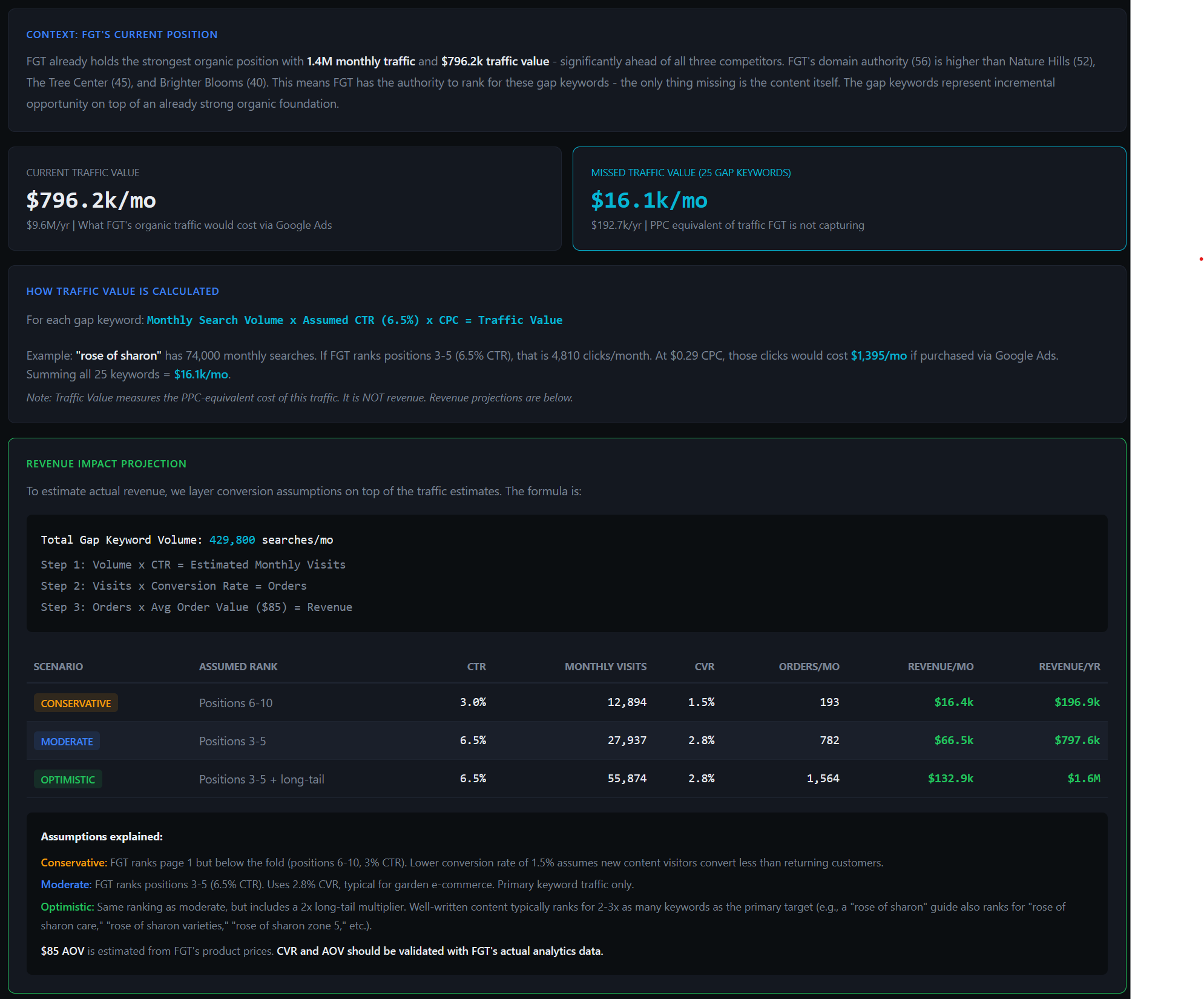
We modeled three scenarios for the 15 recommended articles, translating keyword volume into estimated e-commerce revenue using CTR, conversion rate, and average order value assumptions:
Scenario
Monthly Revenue
Annual Revenue
Conservative (positions 6–10, 1.5% CVR)
$16,400
$197K
Moderate (positions 3–5, 2.8% CVR)
$66,500
$798K
Optimistic (positions 3–5 + long-tail)
$132,900
$1.6M
The moderate scenario is the most instructive. It assumes Fast Growing Trees ranks positions 3–5, which is realistic given a domain authority that’s already the highest in the competitive set. At 2.8% conversion — consistent with garden e-commerce benchmarks — the 15 articles generate approximately $760,000 per year in incremental revenue.
Revenue impact across three scenarios — conservative to optimistic.
And these 15 articles represent only the first phase. The full gap analysis identified 375 qualified keywords. Covering more of them means proportionally more revenue. At 50+ articles, Fast Growing Trees would approach the content depth of Nature Hills and could realistically capture the majority of informational search traffic in the online nursery space.
Importantly, these revenue projections only capture the traditional SEO channel. They do not account for the additional traffic driven by AI citations — which is a growing and increasingly significant channel that compounds on top of the keyword-driven revenue.
Broader observations
The pattern in this analysis is not unique to the online nursery space. The same dynamic is likely present in any vertical where:
The leading player has strong products and domain authority but limited informational content.
Competitors have invested in blog content, guides, and educational material.
Customers research before purchasing — comparing varieties, reading care guides, asking “which is best for my situation.”
AI platforms are increasingly synthesizing answers to those research queries.
That describes a wide range of e-commerce, B2B, and service businesses. Traditional keyword analysis remains critically important — organic results still drive the majority of search traffic. But AI-mediated search is a growing channel, and the data from this analysis suggests that the content strategy serving one channel also serves the other. Informational content that ranks well in organic search is the same content that AI platforms cite. The two strategies converge rather than compete.
The interesting question going forward is how quickly this shift continues. In this particular competitive set, the company with the strongest organic fundamentals was the weakest in AI citations — entirely because of a content gap. That gap is addressable. Whether and how quickly it gets addressed will determine how much of the AI-mediated search traffic flows to Fast Growing Trees versus its competitors.
Interested in a similar analysis?
We run Content Gap & AI Visibility analyses across e-commerce, B2B, and services. If you’re curious how your domain performs in AI-generated results relative to competitors, reach out.